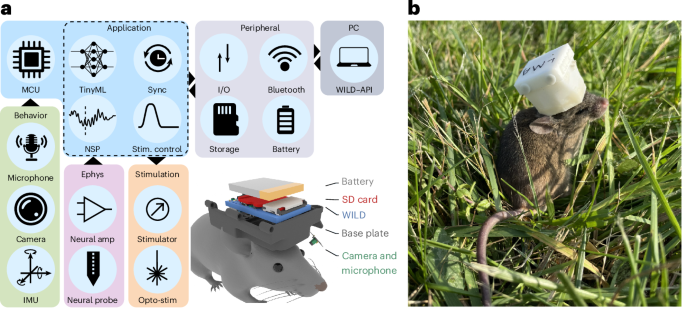
Studying the brain mechanisms of natural behaviors is experimentally challenging. We developed a miniaturized, wireless platform to record and manipulate neural and physiological activity in small animals, enabling the study of neural mechanisms underlying rodent social group behaviors across laboratory and outdoor natural environments. This is a preview of subscription content, access via your institution Access Nature and 54 other Nature Portfolio journals Get Nature+, our best-value online-access subscription Receive 12 print issues and online access Prices may be subject to local taxes which are calculated during checkout Steinmetz, N.
Neuropixels 2.0: a miniaturized high-density probe for stable, long-term brain recordings. Science 372, eabf4588 (2021). This paper introduced Neuropixels 2.0, large-scale, high-density silicon probes that allow recording from hundreds of channels in behaving animals.
Article CAS PubMed PubMed Central Google Scholar Kendall-Bar, J. Brain activity of diving seals reveals short sleep cycles at depth. Science 380, 260–265 (2023).
In this paper, the authors performed EEG and accelerometer recordings in free-diving seals in the open sea to study their natural sleep patterns. Fernandez-Ruiz, A., Oliva, A. & Chang, H. High-resolution optogenetics in space and time.
Trends Neurosci. 45, 854–864 (2022). This review article presents recent advances in high-resolution and closed-loop optogenetic manipulations of neural activity in behaving animals. EthoLoop: automated closed-loop neuroethology in naturalistic environments.
Methods 17, 1052–1059 (2020). This paper presents Etholoop, a system for real-time optical tracking and behavioral control, and deploys it to study mouse lemurs in complex 3D environments. Mapping the landscape of social behavior.
Extract — continue reading at the source.


