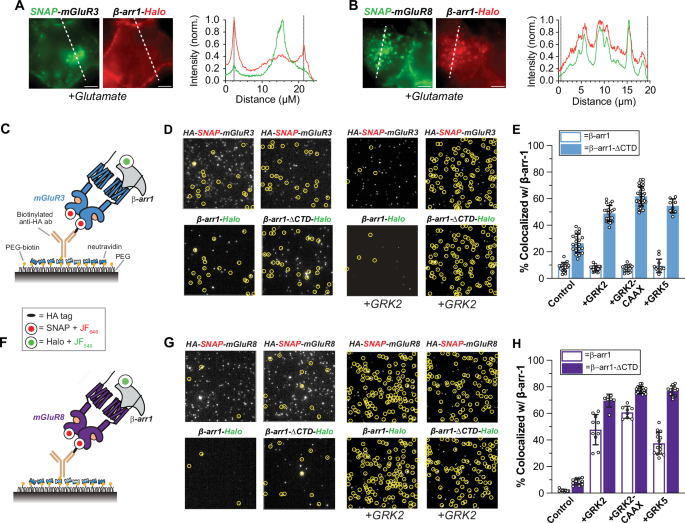
Beta-arrestins (β-arrs) are cytosolic proteins which mediate G protein-coupled receptor (GPCR) desensitization, endocytosis, and signaling. Despite the widespread physiological roles of β-arr coupling, the molecular basis of GPCR/β-arr interaction has been studied primarily in monomeric family A GPCRs. Here we develop a single molecule pulldown (SiMPull) assay that reports on both relative GPCR:β-arr interaction strength and stoichiometry to uncover molecular diversity in β-arr coupling to the neuromodulatory metabotropic glutamate receptors (mGluRs), prototypical, dimeric family C GPCRs.
We find that mGluRs couple to β-arrs with variable apparent strength and a 2:1 or 2:2 stoichiometry. Focusing on the mGluR8/β-arr1 interaction, we map the contributions of “tail” and “core” interactions with residues in the receptor C-terminal domain and intracellular loops, respectively. Combinatorial mutagenesis enables the identification of a landscape of β-arr complexes with homo- and hetero-dimeric mGluR8, including both “cis” and “trans” interactions.
Finally, we use our SiMPull assay in conjunction with live cell imaging and transcriptomic analysis to reveal that mGluRs can form megacomplexes either by simultaneously binding β-arr1 and β-arr2 or β-arr and G proteins. Together, this study provides a comprehensive framework for mGluR/β-arr complex diversity, expanding the known range of GPCR/transducer coupling modes. G protein-coupled receptors (GPCRs) are finely tuned transmembrane signaling molecules that sense extracellular stimuli and activate a wide range of intracellular effector pathways1.
The precise signaling of GPCRs is central to diverse physiological processes, underscoring their role as major drug targets2,3. Given their biological and therapeutic significance, great effort has been undertaken to understand the regulatory processes that control GPCR function. A major form of GPCR regulation depends on the multifunctional, cytosolic β-arrestins (β-arr1, β-arr2) which bind to activated GPCRs that have been phosphorylated by G protein-coupled receptor kinases (GRKs)4,5.
Following recruitment and complex formation, β-arrs can desensitize GPCR signaling by sterically blocking G protein access and initiating receptor internalization via clathrin recruitment. β-arr mediated receptor internalization can be subdivided into two classes: receptors that transiently recruit β-arrs to the plasma membrane but do not co-internalize and typically undergo endosomal recycling (class A), and receptors that form stable β-arr complexes that persist into endosomes and typically undergo lysosomal degradation (class B)6,7,8,9,10. In addition to their roles in receptor desensitization, β-arrs can also serve as scaffolds to initiate secondary waves of signaling11. Biophysical and structural studies have shown how phosphorylated GPCR C-terminal tails mediate β-arr recruitment and activation12,13,14,15,16,17 and how β-arrs undergo stepwise recruitment via “tail” and “core” interactions with GPCRs6,18,19,20,21,22,23.
However, the details of β-arr coupling can vary dramatically between GPCR subtypes6,24,25,26,27,28,29,30,31,32, between β-arr subtypes24,33,34,35,36, and between different ligands for the same GPCR37,38,39,40,41,42,43, motivating ongoing studies of β-arrs across the vast landscape of GPCR signaling and regulation. β-arr coupling has primarily been studied in the largely monomeric family A and family B GPCRs, leaving potential differences in other branches of the diverse GPCR superfamily uncharacterized. Family C GPCRs, including the prototypical metabotropic glutamate receptors (mGluRs), the GABAB receptors (GABABR), and calcium-sensing receptor (CaSR), possess distinctive structural features, including large extracellular ligand binding domains (LBDs) and constitutive dimerization44,45. These properties raise key questions about activation and coupling to G protein and β-arr transducers, including: what stoichiometries and configurations do receptor/transducer complexes adopt in homo- or heterodimeric GPCRs?
Extract — continue reading at the source.


