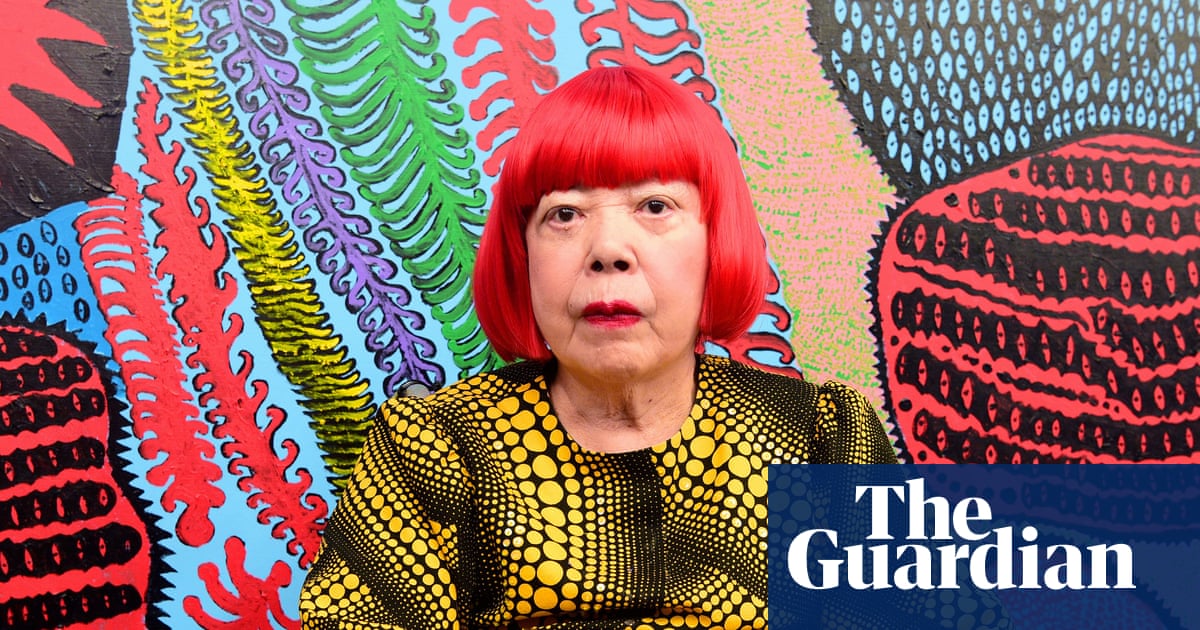
The Japanese artist Yayoi Kusama, who has died aged 97, created an exhilarating oeuvre of polka-dotted paintings, stuffed cloth phalloi and provocative happenings, films and installations, as well as a curate’s egg of novels and poetry. Kusama’s autobiography, Infinity Net (2002), relates her work directly to the obsessions and neuroses from which she suffered throughout her life: “From my very earliest memories, I have felt imprisoned by the walls of my eyes and ears and heart, upon which have been emblazoned all manner of things – nature, the universe, people and blood and flowers…. The only way for me to elude these furtive appearances is to recreate them visually with paint, pen or pencil in an attempt to decipher what they are.” When she first arrived in New York in the late 1950s, critics and fellow artists praised her originality.
Kusama’s friend Donald Judd, the minimalist artist, described her as transcending “whatever ... is oriental or American” but nonetheless emphasised her shallow pictorial space and other formal qualities associated with contemporary art in New York. Kusama characterised her own work in a letter to the American painter Georgia O’Keeffe as “oriental mystic symbolism”. More recently, feminist writers such as Izumi Nakajima have discussed her highly original response to her identity as an Asian woman in a white male art world.
Most interpretations of Kusama’s career have relied, at least partly, on examining her tortuous early life. She was born into a provincial bourgeois family that had made its fortune from cultivating nursery seedlings, at Matsumoto, in the mountainous Nagano prefecture north-west of Tokyo. Her father, Kamon, was a man of “extravagant and incorrigible profligacy”, she wrote, to which Kusama attributed many of her psychological problems.
Her mother, Shigeru, “perpetually angry” and bitterly opposed to Yayoi becoming an artist, also played her part. Kusama still managed to pursue her painting, compensating for the shortage of canvases in 40s Japan by reusing pieces of plant sacks and gaining inspiration from the brilliantly coloured flowers cultivated by her family. Her creativity was already linked to disturbing hallucinations: even the violets she depicted had a tendency to adopt human characteristics or to attach themselves to her.
As she was to write in her poem Violet Obsession (1978), “One day suddenly my voice / became the voice of a violet / … The violets on the tablecloth break free / and crawl over my body /... O violets, little flowers – don’t talk to me / Give me back the voice that became a violet’s voice / I don’t want to be an adult – not yet.” This inability to distinguish herself from her surroundings was to be the principal reason for Kusama’s famous obsession with the polka dot. This apparently harmless motif became in her hands a weapon of “self-obliteration”, spreading like measles across much of her work.
It created a powerful effect of formlessness and loss of individuality, whether appearing on paintings, sculptures or even the human body – her own or other people’s. Although generally associated with later phases in Kusama’s career, coloured dots had first appeared in a drawing of a woman, apparently her mother, which the budding artist made when she was 10 years old. By the early 50s Kusama was producing striking abstract watercolours such as Infinity Polka Dots (Red) of 1951, together with more obviously surrealist works that seemed to present simultaneous visions of both microscopic and cosmic reality.
Extract — continue reading at the source.