Out there in space, blazing just a scant 150 million kilometers away lies the brightest and most massive object in our Solar System: the Sun. Shining hundreds of thousands of times as bright in Earth’s skies as the next brightest object, the full Moon, the Sun is unique among Solar System objects for producing its own visible light, rather than only appearing illuminated because of reflected light. However, the thousands upon thousands of stars visible in the night sky — escalating into the millions and billions when we aid our vision with telescopes and cameras — are all also self-luminous, distinguishing themselves from the planets and other Solar System objects in that regard.
Unlike the planets, Sun, and Moon, the stars appear to remain fixed in their position over time: not only from night-to-night but also throughout the year and even from year-to-year. We even call it “the fixed background of stars” when measuring the motion of objects within our Solar System against them. Compared to the objects in our own Solar System, the stars must be incredibly far away.
And therefore, in order to be seen from such great distances, they must be incredibly intrinsically bright. It only makes sense to assume, as many did dating back to antiquity, that those stars must be Sun-like objects located at great distances from us. But how far away are they?
It wasn’t until the 1600s that we got our first answers, one each from three titans of physics history: Unsurprisingly, those early answers didn’t agree with one another, but who came closest to getting it correct, and whose methods helped us the most in the centuries to come? The story is as educational as it is fascinating. The stars that are closest to Earth will appear to shift periodically with respect to the more distant stars as the Earth moves through space in orbit around the Sun.
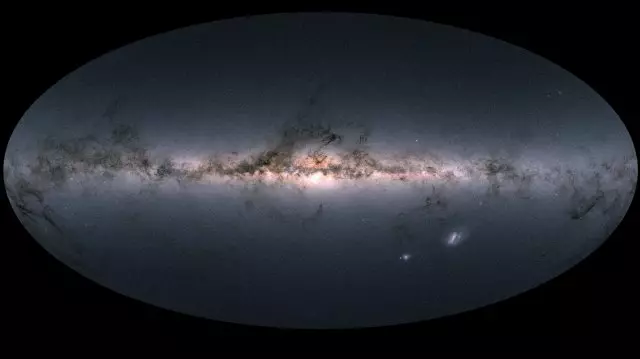
Before the heliocentric model was established, we weren’t looking for “shifts” with a ~300,000,000 kilometer baseline over the span of ~6 months, but rather a ~12,000 kilometer baseline over the span of one night: Earth’s diameter as it rotated on its axis. The distances to the stars are so great that it wasn’t until the 1830s that the first parallax, with a 300 million km baseline, was detected. Today, we’ve measured the parallax of over 1 billion stars with ESA’s Gaia mission.
The simplest, most straightforward and direct way to measure the distances to the stars is one that dates back thousands of years: the notion of stellar parallax. The idea is the same one as the phenomenon behind the game we all play as children, where you: Whenever you have two different vantage points to look from (such as each of your two eyes), objects that are close by will appear to “shift” relative to the objects that are farther away. This phenomenon, known as parallax, could theoretically be used to measure the distances to any of the stars, but would be most easily leveraged for the closest stars of all.
Extract — continue reading at the source.