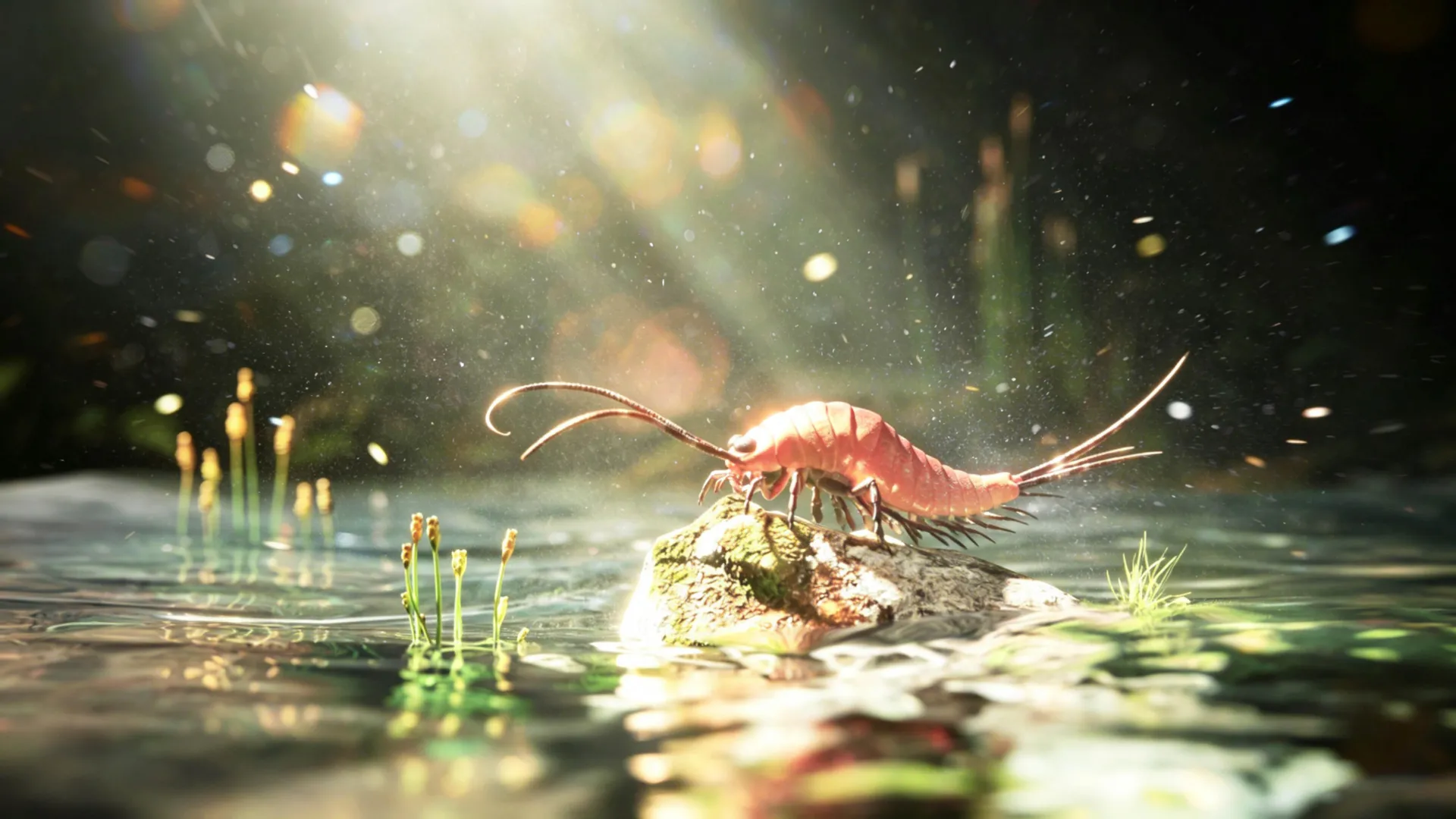
The rise of complex ecosystems on land was one of the major turning points in the history of life. As organisms expanded beyond the oceans, terrestrial environments became home to increasingly diverse communities. Insects, which today make up the most species-rich animal group on Earth, eventually became central to these ecosystems.
Yet important parts of their early transition from water to land have remained unclear. An international team of researchers has now identified a stem group insect from the Late Mississippian period, about 324 million years ago. By studying this fossil alongside other puzzling specimens from much earlier and later periods, the researchers reconstructed a critical stage in early insect evolution.
Their findings suggest that insects did not become fully terrestrial immediately after beginning to colonize land. Instead, early forms retained and modified features inherited from aquatic ancestors, spending an extended period in a semi-aquatic, amphibious way of life. The research was led by Prof.
Chenyang Cai of the Nanjing Institute of Geology and Paleontology of the Chinese Academy of Sciences (NIGPAS) and Erik Tihelka, a joint training Ph.D. student at the University of Cambridge. They worked with researchers from the United States, Spain, and other countries. The findings were published in Nature on August 26.
A New Species From 324 Million Years Ago The researchers describe a new species called Chosha praecursor. They also reexamined mysterious stem insect fossils from the Early Devonian chert deposits of Britain and the Late Carboniferous Mazon Creek biota in the United States. Together, these fossils help close major gaps in the early history of insects.
They also challenge long-standing ideas about how the insect body plan developed and how pancrustacean ancestors made the transition onto land. Most importantly, the specimens provide direct fossil evidence that the shift from aquatic to terrestrial life occurred gradually. Molecular clock studies have suggested that hexapods split from their marine crustacean relatives and began adapting to terrestrial environments as early as the Cambrian-Ordovician interval.
Extract — continue reading at the source.