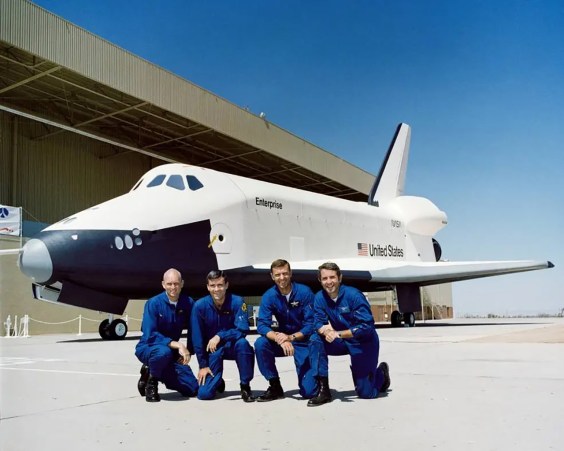
On September 17, 1976, NASA proved its determination to boldly go where no one else has gone before, with the unveiling of its first space shuttle at the Rockwell International manufacturing plant in Palmdale, California. In attendance: Star Trek creator Gene Roddenberry and several members of the show’s cast. In the weeks prior, roughly 100,000 Star Trek fans wrote to the White House requesting that the shuttle be called the Enterprise after the iconic spaceship helmed by Captain Kirk.
With the blessing of President Gerald Ford, they got their way. The shuttle was originally going to be called Constitution, but it became Enterprise instead. Despite being the first space shuttle, the Orbital Vehicle-101 (OV-101)—Enterprise’s more technical name—never actually went to space.
Rather, NASA used it to run test flights and diagnostic checks to help develop the space shuttles that would follow—there would be five of them in all. Enterprise now enjoys retired life at the Intrepid Museum in New York City. The original plan was to refit Enterprise after testing so it would be capable of orbital flight, but redesigns meant it eventually made more sense to use a different test frame for the job, which became the Space Shuttle Challenger (OV-102).
Enterprise was fixed to a Boeing 747 for its earliest test missions, with the first independent flight taking place on August 12, 1977. It then completed four more 747-free flights, finishing the last one on October 26th of the same year, while NASA scientists made key checks around performance and safety. Read more: “How Star Trek May Show the Emergence of Human Consciousness” The final flight demonstrated how necessary these tests were: The mission revealed a problem with the control systems called Pilot-Induced Oscillation (PIO), which caused flight deviations to be overcorrected.
This was fixed for the subsequent shuttles that did make it out of Earth’s atmosphere, starting with Columbia (OV-102), which made its first flight in 1981. Space shuttle flights continued until 2011, when growing concerns around costs and safety (two shuttles and their crews were lost to disasters) made them unpopular. However, across the three decades that these spacecraft were in service, they achieved a lot.
Across 135 missions, hundreds of astronauts were carried into space, the Hubble Space Telescope was placed into orbit (and subsequently repaired), probes were sent off to Jupiter and Venus, and much of the International Space Station was constructed. Enterprise marked the start of the first significant success for reusable space technology, and its lessons are still being applied today. It’s also more evidence, as if we needed it, of the passion of Trekkies.
Extract — continue reading at the source.