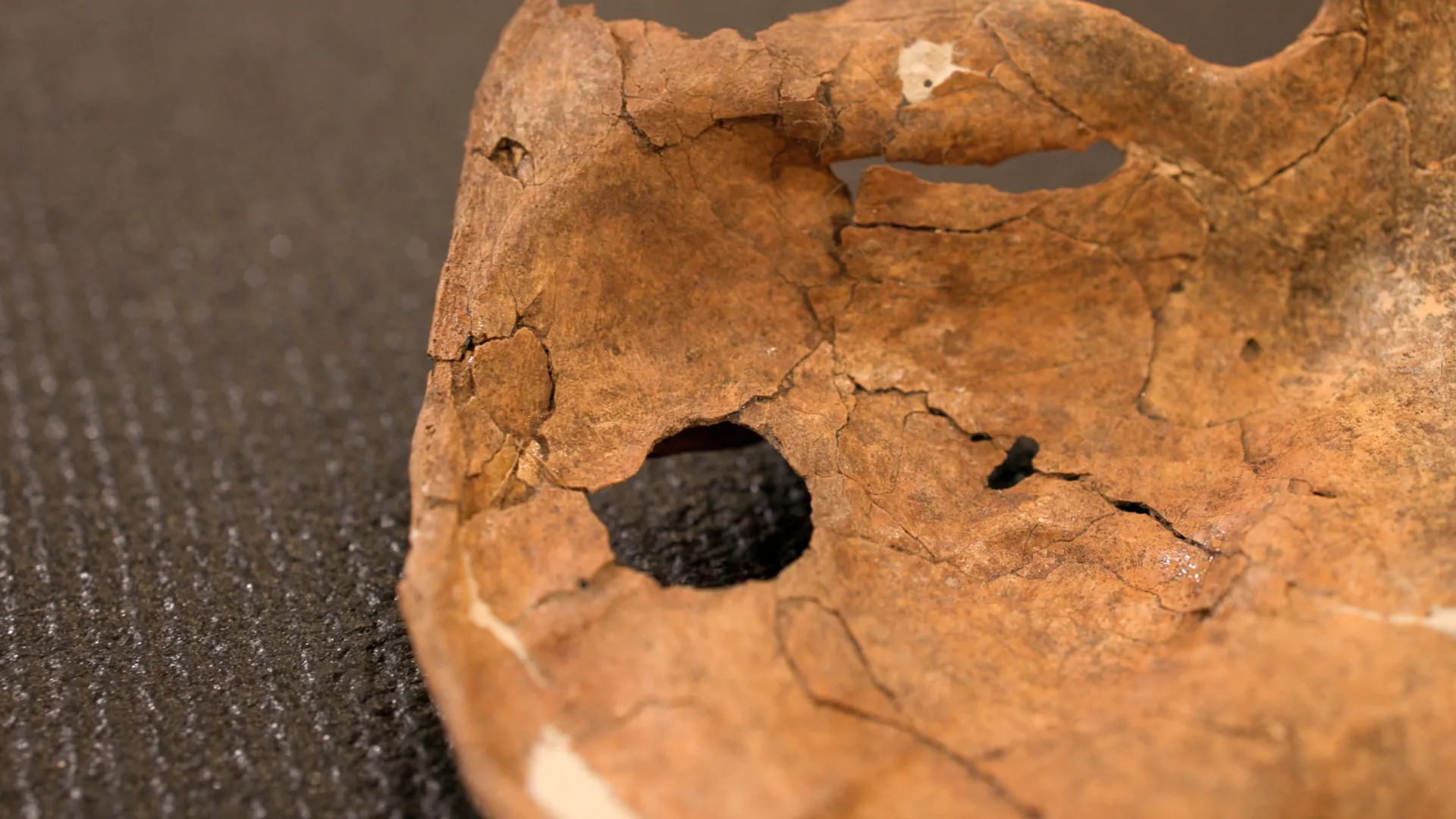
A small, circular hole in a 75,000-year-old Neanderthal shoulder blade may reveal one of the earliest known cases of deadly violence involving a wooden spear. The remarkable discovery, made in a cave in Iraqi Kurdistan, suggests that the individual was struck by a sharpened wooden weapon that passed through the chest, potentially in a deliberate attack aimed at the heart. Researchers believe the wound could represent the oldest evidence in the hominin fossil record of fatal interpersonal violence involving a wooden spear.
The shoulder blade (scapula) is an unusually delicate bone, with some areas so thin that light can pass through them. Despite its fragile structure, the Neanderthal's bone survived for approximately 75,000 years beneath seven and a half meters of rock and sediment. Almost the entire bone remained intact, except for a remarkably precise circular opening measuring 15 millimeters across.
A Deadly Spear Wound Reveals a Neanderthal's Violent Death Archaeologists from the University of Cambridge, who led the excavation, believe the hole was created by a spear with a sharpened wooden point. Its rounded shape is an important clue because weapons tipped with flint or stone generally produce openings with flatter or more angular edges. Their reconstruction suggests that the spear entered the front of the Neanderthal's left chest, passed through a lung and probably major blood vessels, and continued until it pierced the shoulder blade from behind.
Such a severe injury would have caused rapid death. The researchers suspect the blow may have been an intentional "heart shot." The physical evidence offers additional clues about how the attack occurred. The opening has beveled edges, a feature commonly associated with an exit wound.
Small bone fragments displaced during the impact indicate that the weapon likely entered from above and traveled downward through the body. Using these fragments, the scientists were able to partially reconstruct the damaged area. Subtle ridges left by muscle attachments helped them determine where the pieces originally belonged.
"It's extraordinary to have a perfectly preserved scapula from 75,000 years ago. These bones are so thin that you often don't get complete scapulae from modern burials," said Dr. Emma Pomeroy, study lead author from Cambridge's Department of Archaeology.
Extract — continue reading at the source.