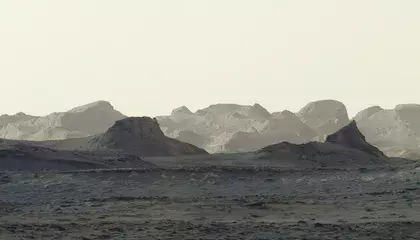
But the panorama was captured millions of miles away from our planet, on a world whose nickname stands in stark contrast with the neutral tones of the image: Mars. Indeed, NASA’s Curiosity rover used its Mastcam to snap the six images that make up the landscape on August 11 at 8:30 a.m. local Mars time, which scientists then stitched together after the rover sent them back to Earth. The final product presents the most detailed view scientists have ever had of wind-carved Martian cliffs, including crags known as yardangs.
"This scene has a wildness that reminds me of a road trip through Monument Valley, Arizona. You can almost feel the silence and the endless open space under the sky,” Ashwin Vasavada, a planetary scientist and the Curiosity project scientist, tells ’ Will Dunham. It's like Earth, but it's definitely Mars.” The yardangs sit on the northwest side of a three-mile-tall mountain called Mount Sharp, and both features sit in Mars’ Gale Crater, according to the outlet.
Curiosity landed on Mars in 2012 and has been climbing Mount Sharp since 2014. On August 26, it reached 0.6 miles of elevation, which is a record for Martian rovers. Mount Sharp’s layers preserve materials from different periods of Mars’ history.
Their analysis has shed light on the lakes and streams that existed there billions of years ago, when the Red Planet hosted a much wetter environment. When the water dried up it left behind layers of minerals, and when the deposits stopped accumulating on Mount Sharp, wind possibly eroded the yardangs into being. However, “the yardang layer looks out of place.
It’s the wrong color, the layers tilt at an odd angle, and it almost appears plastered on,” Vasavada says in a NASA statement. No one is sure exactly what created this layer, but one idea is it may be ash deposited by ancient volcanic eruptions.” In fact, the yardangs don’t seem to be part of the rest of Mount Sharp’s layers, Vasavada adds to . Scientists are aiming for Curiosity to reach the base of the yardangs in 2027.
When it launched in 2011, the rover was the largest and most capable ever sent to Mars. Curiosity’s objective is to understand if Mars could have ever hosted extraterrestrial microbes, and the rover made headlines earlier this year when it discovered organic molecules that represent the building blocks for life. Mars “had all the conditions for life to start there when life was starting on Earth,” Andrew Coates, a planetary scientist at University College London’s department of space and climate physics, told the Guardian’s Hannah Devlin at the time of the discovery.
Extract — continue reading at the source.