/https://tf-cmsv2-smithsonianmag-media.s3.amazonaws.com/filer_public/40/c6/40c683bd-0e63-413a-84e0-9393057242ad/stirling-castle.png)
In 1304, Edward I of England unveiled a powerful new weapon in his fight against Scotland. Known as the War Wolf, the siege engine was the largest wooden trebuchet ever built, capable of launching projectiles that weighed more than 300 pounds. According to a 19th-century history, the weapon smashed through the walls of Scotland’s Stirling Castle as easily “as an arrow would fly through a piece of cloth.” More than 700 years after Edward cowed the Scots into submission (albeit temporarily), archaeologists have uncovered a rare reminder of the damage inflicted by the king’s siege engines.
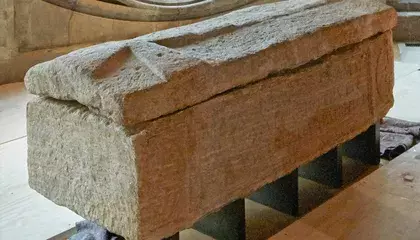
As Jo Buckberry, a bioarchaeologist at the University of Bradford in England, announced at a recent meeting of the Paleopathology Association, a skeleton excavated at the Scottish castle bears more than 160 fractures sustained at or around the time of death, with most of the injuries concentrated on the skull and the ribs. Buckberry argues that the man’s remains represent the first known evidence of trebuchet trauma in the archaeological record. But how do you get from there to a guy in medieval Scotland?
What is large and moving very, very quickly in 1304?” The answer, Buckberry concluded after comparing the man’s injuries to other documented cases, was probably a large stone that struck his right shoulder and the back of his head with great force, pinning him to the ground. Radiocarbon dating of the skeleton—one of nine unearthed at Stirling Castle in 1997—indicates that it dates to the Wars of Scottish Independence, which spanned 1296 to 1357. Unlike most other medieval victims of wartime violence, the man’s remains show no signs of injuries sustained in hand-to-hand combat.
Instead, “it’s all these crushing injuries, sort of blunt force injuries,” Buckberry told historian Matt Lewis in a video shared by History Hit. Whether the man, who died between the ages of 22 and 34, was a victim of War Wolf itself is unknown, but Buckberry finds it “quite likely” that he succumbed to a missile launched by one of Edward’s trebuchets, whether it was the record-breaking weapon or an earlier model. At the time of the siege, Stirling Castle was the last remaining stronghold of the Scottish independence movement.
By 1304, William Wallace, the freedom fighter immortalized in the 1995 film Braveheart, was on the run from the English; he would soon be captured and executed. The vast majority of Scotland’s nobles had surrendered to Edward, leaving just one defender to mount a final stand against the king. The remaining Scots held out for three months but surrendered when confronted with “the destructive power of Edward’s hugely expensive new toy,” War Wolf, James Macivor wrote for Historic Environment Scotland in 2024.
According to Michael Prestwich’s 1997 biography of the king, the trebuchet wasn’t yet finished when the garrison yielded, but Edward, who “wanted to see how effective the new machine was … refused to let anyone enter or leave the castle until it had been tried out.” Was this final attack the one that killed the man studied by Buckberry? If so, he must have been exceptionally unlucky. In 1314, forces led by King Robert the Bruce dealt a devastating blow to the English at the Battle of Bannockburn, paving the way for England’s official recognition of Scottish sovereignty in 1328.
Extract — continue reading at the source.