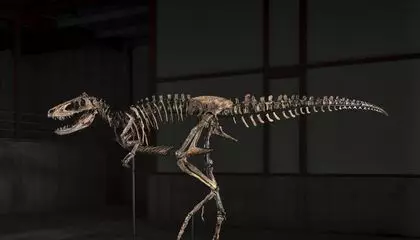
One year after the Nanotyrannus genus was largely confirmed as separate from its Tyrannosaurus rex cousin, the world’s most complete Nanotyrannus skeleton sold at auction for a whopping $47.3 million dollars. It’s now the second most valuable dinosaur ever sold, although auction house Sotheby’s has not disclosed the buyer. Dubbed “Jodi,” the roughly 67-million-year-old skeleton measures nearly 10 feet tall and just over 19 feet long.
The adult specimen represents one of three mostly complete Nanotyrannus skeletons and features bones including a skull, around 50 teeth, a pelvic girdle, many leg and arm bones, claws, and dozens of vertebrae and ribs, according to another statement. The fossil’s namesake, rancher Jodi Pierson, discovered the Nanotyrannus remains on her land in Montana in 2019. The fossil was preserved in the Hell Creek Formation, a fossil-rich rock formation that stretches across Montana, the Dakotas and Wyoming.
Pierson’s cousin Clayton Phipps, a commercial paleontologist nicknamed the “Dinosaur Cowboy,” excavated the skeleton. This exceptional fossil became part of an enduring debate. It all started when paleontologists in Montana excavated a small Tyrannosaurus rex-like skull in 1942.
Analyses of it split the research community into two camps: those who suspected it represented a new genus and species, N. lancensis, and those who instead suspected that it was just a young T. rex. More than 80 years later, Nanotyrannus supporters appear to have won. In a Nature study published in October 2025, researchers claimed to have conclusively demonstrated that Nanotyrannus was its own genus and includes two known species, N. lancensis and N. lethaeus.
They investigated a teensy tyrannosaur specimen from a larger fossil unit nicknamed the “Dueling Dinosaurs,” in which a Nanotyrannus and Triceratops look like they’re fighting. Jodi was found just eight miles from where the Dueling Dinosaurs were discovered in 2006. Jodi is a Nanotyrannus cf. lancensis, though “cf.” means that the identification is still uncertain.
In fact, the New York Times’ Sopan Deb reports that some scientists still argue over whether there are two distinct species in the genus. Sotheby’s estimated Jodi would fetch between $6 million and $9 million. But by the end of an intense 12-minute bidding battle between six contenders on October 27, the skeleton sold for more than five times the high end of its maximum evaluation.
Extract — continue reading at the source.