On a foggy October day in 1944, a small crew of American airmen stationed in England began preparations for a test flight of a B-24H Liberator nicknamed “Sack Time!” As the plane was readied for its cross-country training exercise, Corporal Clarence Watson, a 21-year-old from California who worked on the plane’s ground crew, finally got his chance to sit in on a flight. The crew he joined was part of the top-secret Operation Carpetbagger. Launched in 1943 by the Office of Strategic Services, Operation Carpetbagger consisted of high-risk clandestine missions to supply partisan fighters deep in Nazi-occupied Europe.
Usually flying at night or in inclement weather, the crews piloted black planes at abnormally low altitudes to airdrop supplies and parachutists to aid resistance fighters. Most of these flights departed from England and sent deliveries to France in advance of the D-Day invasion. But even test runs for Operation Carpetbagger were dangerous.
Visibility was exceptionally poor over West Yorkshire when “Sack Time!” crashed into an obscured hill in England’s Peak District. Seven crew members died on impact. An eighth died later that night.
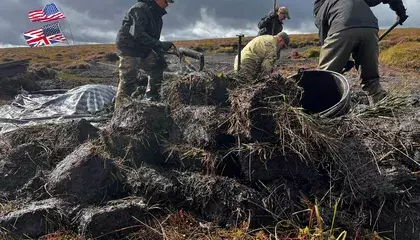
The crash’s sole survivor, Staff Sergeant Curtis Anderson, used hunks of wet peat to extinguish the fire enveloping him, according to the Yorkshire Post’s Ruby Kitchen. One mystery lingered from that tragedy: Watson’s body was never found, and he has officially remained missing in action ever since. Now, 82 years later, the search for Watson’s remains has been revived.
Geoscope, a U.K.-based forensic archaeology firm, in partnership with the U.S. government, is reopening the search in hopes of bringing closure to Watson’s family. Recently, however, members of Wilson’s family learned that the military may have found some evidence at the crash site during initial recovery efforts: a piece of a parachute, the back of a watch and a hip bone that may have belonged to Wilson. She explains that, without confirmation of Wilson’s demise, her family continued to hold out hope.
In 2023, a cursory survey of the crash site and surrounding areas identified several nearby locations where more evidence related to Watson was likely to be found. Archaeological research teams are now excavating those sites, hoping that the moor’s unique ecology may have preserved evidence of Wilson’s body. Weatherby recently visited the excavation site.
Extract — continue reading at the source.



/https://tf-cmsv2-smithsonianmag-media.s3.amazonaws.com/filer_public/9f/b3/9fb3bc09-c4b9-4bf9-a618-b7e1de91b8ae/rare-haul-of-wooden-ob-1.jpg)

