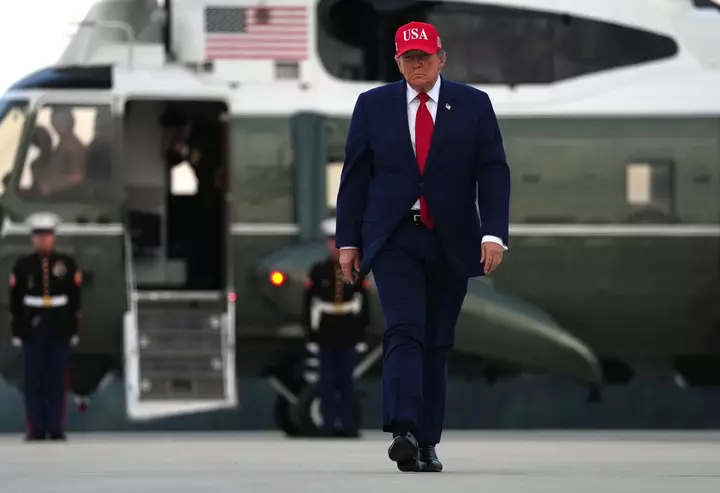
President Donald Trump confirmed Saturday that he had discussed Taiwan at his summit with Chinese leader Xi Jinping last week, saying that Xi “understands” his position on the democratic island. It’s just moving along,” he told reporters at the White House. He understands very much how I feel.” Trump’s comments did not indicate any shift in Washington’s decades-old position, despite Xi’s explicit call at the summit for the U.S. to “oppose” Taiwan independence.
China claims democratic Taiwan as its own and has vowed to bring it under its control, by force if necessary. It calls Taiwan the “core of its core issues” and says the issue is an internal affair. Beijing regularly sends military ships and jets around the democratic island as part of a concerted bid to pressure Taipei.
The U.S. does not have formal diplomatic relations with Taiwan, but retains a “robust unofficial relationship” and is bound by law to help the island defend itself. Washington has traditionally said it “does not support” formal independence by Taiwan, but has also stopped short of explicitly saying it “opposes” such a move. Although any shift in language would be subtle, experts have argued that it could be employed by Beijing to erode Taiwan’s confidence in U.S. support for the island’s defense.
At their summit Thursday, Xi said Beijing’s position on the island is “clear cut.” “It is hoped that the U.S. side will adhere to the correct position of opposing ‘Taiwan independence,’ and handle the Taiwan question with caution, so as to lay a solid foundation for China-U.S. strategic cooperation and the development of bilateral relations,” Xi told Trump, according to the Chinese Foreign Ministry. Taiwan did not feature in either of two documents released Saturday by the two sides, a possible indication of the lack of agreement on the issue. A fact sheet on the summit released by the White House focused on building “a fair and reciprocal relationship,” and did not touch on the flash point island, instead emphasizing the importance of the American military’s presence in Asia.
The U.S. has for decades maintained a position of “strategic ambiguity” toward the island that is intended to not only deter China from using force against Taiwan but also dissuade Taipei from seeking formal independence while giving Washington breathing room in its ties with both. The Chinese side, meanwhile, released a list of “eight deliverables and understandings” it said the two countries had agreed on, as well as a claim that the Chinese and U.S. militaries had agreed “to conclude a memorandum of understanding on crisis communication and prevention as soon as possible.” Neither side mentioned U.S. arms sales to Taiwan, an issue that featured prominently in the wake of the Xi-Trump summit in May. Following that meeting, Trump questioned whether it made sense for U.S. forces to “travel 9,500 miles to fight a war” and said he considered a pending $14 billion American arms sales package to Taiwan as leverage in his dealings with the Chinese leader, calling it “a very good negotiating chip.” While there was no news on that front, Trump did announce that he and Xi would meet twice more this year, in November at the Asia-Pacific Economic Cooperation (APEC) summit in the Chinese city of Shenzhen and and in Miami in December at a Group of 20 summit.
Analysts said that with those meetings scheduled, the Trump administration is highly likely to halt arms sales to Taiwan until after they are concluded.
Extract — continue reading at the source.