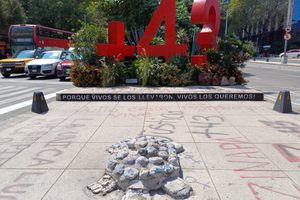
These "antimonuments" confront the Mexican authorities by memorializing the most troubling events in the country's modern history. The turtle, with its slow pace, has become a symbol of inefficiency in the Ayotzinapa case. linkogecko / Atlas Obscura User 50th anniversary of El Halconazo. linkogecko / Atlas Obscura User Antimonument of the Tlatelolco Massacre, which took place before the Mexico City Olympics. linkogecko / Atlas Obscura User +43 antimonument and Revolution Monument. linkogecko / Atlas Obscura User An example of antimonumenta outside Mexico City. This one is in the Parque Hidalgo in Pachuca, a nearby state capital. linkogecko / Atlas Obscura User Glorieta de las Mujeres que Luchan - Roundabout of the Women who Fight. linkogecko / Atlas Obscura User Portraits of the Ayotzinapa victims on the right. linkogecko / Atlas Obscura User The number 43 is now synonimous with the Ayotzinapa students. linkogecko / Atlas Obscura User Protest against femicide near a feminist antimonumenta. linkogecko / Atlas Obscura User The turtle, with its slow pace, has become a symbol of inefficiency in the Ayotzinapa case. linkogecko / Atlas Obscura User 50th anniversary of El Halconazo. linkogecko / Atlas Obscura User Antimonument of the Tlatelolco Massacre, which took place before the Mexico City Olympics. linkogecko / Atlas Obscura User +43 antimonument and Revolution Monument. linkogecko / Atlas Obscura User An example of antimonumenta outside Mexico City.
In this context, the country's civilian population has often taken matters into their own hands regarding self-defense and demands towards the government. This is where the multitude of antimonuments mainly found in the capital come in. Unlike a monument intended to celebrate a particular event, the antimonumentos aim to confront the powers that be (and even the society at large) for failures in the rule of law, corruption, negligence, among others.
From the 1968 state-sponsored Tlatelolco Massacre in the eve of the Mexico City Olympics, to the similar Halconazo of 1971 and the 2021 removal of a statue of Christopher Columbus, the antimonuments represent more than half a century of struggle. The former Glorieta de Colón (Columbus Roundabout) represents one of the best examples of how antimonumentos and specifially, their feminist antimonumenta counterparts, come to be. After the Columbus statue was toppled during a protest against Mexico's shocking rate of femicides and gender-based violence, a purple metal cutout of a woman with a raised fist was installed in its place, and the unofficial renaming to Glorieta de las Mujeres que Luchan (Roundabout of Fighting Women).
Given that Spanish uses grammatical gender for nouns, almost any object in the language will be considered as either male or female. "Monumento" (monument) is male for example, but debates around feminism and gender identity in the 21st century have lead to plenty of cases of male genders being "feminized" as a form of language activism, with examples like "monumenta" and "colectiva". This gives us a clue as to why Mexico (Mexico City in particular) is home to a large number of not only antimonumentos but also antimonumentas.
A common style of these antimonuments features the plus sign followed by a number.
Extract — continue reading at the source.
/https://tf-cmsv2-smithsonianmag-media.s3.amazonaws.com/filer_public/9f/b3/9fb3bc09-c4b9-4bf9-a618-b7e1de91b8ae/rare-haul-of-wooden-ob-1.jpg)




/https://tf-cmsv2-smithsonianmag-media.s3.amazonaws.com/filer_public/d6/34/d6341e1c-dae8-4784-ad3f-1d375b2dbfb4/gettyimages-2281722380.jpg)