Sleep is essential for health, yet studying its dynamics requires manual sleep staging, a labor-intensive step in research and clinical care. Across centers, polysomnography (PSG) recordings are traditionally scored in 30-s epochs for pragmatic, not physiological, reasons and vary in electrode count, montage, and subject characteristics. These constraints challenge harmonized multi-center studies and the discovery of robust biomarkers on shorter timescales.
We present AnySleep, a deep neural network that scores sleep from any electroencephalography (EEG) or electrooculography (EOG) data at adjustable temporal resolutions. We trained and validated the model on over 20,000 overnight recordings (>200,000 h of EEG and EOG) from 28 datasets across multiple clinics to promote robust generalization across sites. The model attains state-of-the-art performance and surpasses or equals established baselines at 30-s epochs.
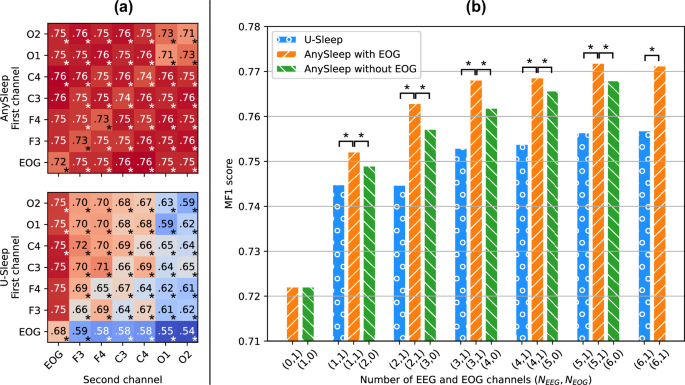
Performance improves with more channels, yet remains strong when EOG is absent, or only EOG or single EEG derivations (frontal, central, or occipital) are available. On sub-30-s timescales, the model captures short wake intrusions consistent with arousals and improves the prediction of pathophysiological conditions (obstructive sleep apnea, narcolepsy type 1, insomnia) over 30-s scoring. We make the model publicly available to facilitate large-scale studies with heterogeneous electrode setups and accelerate biomarker discovery in sleep.
Sleep carries diagnostic and prognostic value across a wide range of conditions, from sleep disorders to cardiometabolic, psychiatric, and neurodegenerative diseases. In clinical practice and research, extracting this information usually requires overnight polysomnography (PSG) and expert annotations (sleep staging), which is work-intensive, costly, and subject to significant inter-rater variability1,2,3. Moreover, sleep dynamics have traditionally been analyzed based on 30-s epochs, a convention originating from the practical constraints of manual annotation on paper strips rather than from any underlying physiological rationale4,5.
This approach has long served as the foundation for sleep research, yet sleep unfolds at temporal resolutions much finer than can be captured by 30-s windows. This is particularly evident in gradual sleep state transitions, which may pass through short intermediate “substages”5,6, or in brief disruptions caused by micro-sleep or micro-arousals. The latter occur on the scale of seconds and play a critical role in various sleep disorders, including REM sleep behavior disorder (RBD), obstructive sleep apnea (OSA), and insomnia7,8,9,10,11,12.
Large-scale studies with shorter timescale annotations would, therefore, be valuable for gaining a deeper understanding of sleep dynamics and discovering novel biomarkers. Yet, despite the availability of large amounts of raw PSG data, conducting large-scale studies based on expert annotations is practically infeasible, as the time and effort required for manual scoring increases substantially with the frequency of annotations. At the same time, empirical studies have demonstrated that shorter annotations lead to increased inter-rater variability12,13,14, although it has been hypothesized that shorter epochs could reduce disagreements by decreasing the number of ambiguous transition epochs15.
Extract — continue reading at the source.