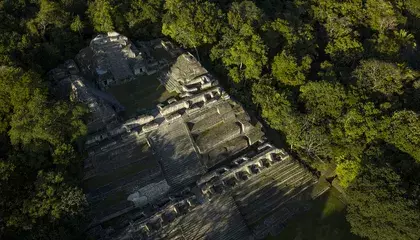
The first visit I made to the Maya ruins in Caracol, Belize, involved a three-hour trip through a labyrinth of deeply potholed dirt roads, in a vehicle helmed by a steel-nerved driver. I spent the ride crouched in the back, trying to ignore the potentially tire-busting jolts. So it seemed like a miracle when I returned just a year later, in the spring of 2026, and found a newly completed highway leading smoothly through the fragrant Mountain Pine Ridge Forest Reserve, past a smattering of logging towns, and into the Chiquibul rainforest, a lush jungle landscape alive with butterflies and songbirds.
When I arrived at the Caracol field camp, I was greeted by Arlen and Diane Chase, both archaeologists at the University of Houston, where Diane also serves as provost. Joining them was their 35-year-old son, Adrian Chase, who is also an archaeologist and currently a postdoctoral fellow at Tulane University’s Middle American Research Institute. Their camp is a semicircle of zinc-roofed, thatch-sided shacks with no running water, no cellphone reception and fickle electrical service.
The students, volunteers and staff who eat, sleep, work and occasionally play here are issued a water jug, a hammock and a machete. When I asked about the latter, Adrian cheerfully explained that he had used his that very morning to behead a fer-de-lance pit viper. Archaeologists once considered Caracol a minor site barely worth their time, but its remoteness turned out to be an asset.
Other Maya strongholds like Tikal in Guatemala and Chichén Itzá in Mexico were first encountered by European colonists in the 19th century. Caracol, hidden in dense tropical forest, had barely been excavated when the Chases arrived in the 1980s. Over the following decades their painstaking work exploded a number of misleading myths about the Maya.
For centuries, most scholarly assumptions about this ancient civilization came from the writings of Friar Diego de Landa, a 16th-century Spaniard who lived as a missionary among the Maya communities in the Yucatán. By his own account, de Landa burned most of the Maya’s hieroglyphic codices. You had knights and nobles in castles, and everyone else was scattered throughout the countryside.
The Spaniards slapped that two-class model onto the Maya.” By the time Arlen and Diane were in graduate school at the University of Pennsylvania in the 1970s, more was known about the ancient culture—for instance, that the Maya had designed one of the world’s most sophisticated calendars and held a deep understanding of astronomy, mathematics and architecture. But most scholars saw the Maya as peaceful stargazers so absorbed by gauzy ceremonial pursuits that they neglected certain practical concerns. In the influential 1954 book The Rise and Fall of Maya Civilization, British archaeologist J.
Extract — continue reading at the source.