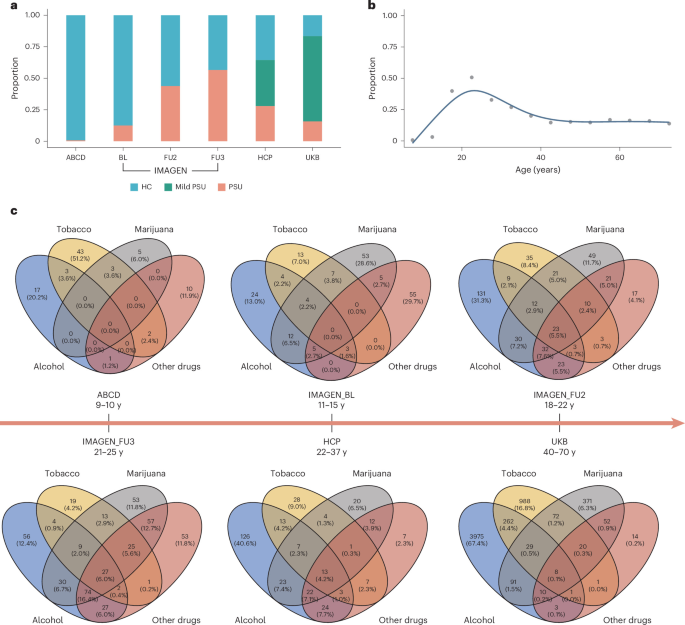
Addiction stands as a critical public health concern, contributing substantially to morbidity, mortality and societal burden worldwide. It can be conceptualized along a developmental continuum, from risky substance use in adolescence to compulsive use and addiction in adulthood, yet the neural changes underlying this continuum remain poorly understood. Here we show age-specific brain structural trajectories along this continuum by harmonizing multimodal data across large population cohorts spanning adolescence to late adulthood.
We identified three life stages with distinct patterns of problematic substance use (PSU). Before age 25, PSU was associated with neurodevelopmental differences, alongside greater impulsivity and rule-breaking, suggesting a key window for early prevention. Between ages 25 and 45, PSU was linked to structural differences in brain regions linked to craving and reward processing, supporting early detection and intervention during the reinforcement and maintenance of substance use.
After age 45, PSU-related brain differences may reflect cumulative effects of prolonged substance exposure, emphasizing broader health monitoring. These stage-specific patterns also differed by sex, particularly earlier in life. Together, our findings map structural brain changes across the addiction continuum and provide a lifespan framework for stage-specific prevention, intervention and health monitoring.
In recent years, lifespan neuroscience has increasingly emphasized how exposures and vulnerabilities at different life stages shape mental health and behavioural outcomes1. This growing interest stems from the reconceptualization of mental disorders, shifting the focus from static cross-sectional psychiatric diagnoses towards a continuum of disorder progression2. The development of addiction naturally provides a unique case for this framework, progressing from risky use to habitual and compulsive substance intake3,4.
Given its substantial burden on mental and physical health5, it is important to elucidate associated age-specific patterns to inform effective prevention and intervention strategies. The early phase of this continuum, which typically begins during adolescence, represents a key period of vulnerability. Early-onset substance use may reflect developmental risk6 and was consistently found to be a potent predictor of future substance dependence7.
With continued use into adulthood, the cumulative neurobiological effects are thought to remodel the prefrontal corticostriatal circuits3,8, resulting in escalating use and the clinical endpoint of addiction. However, neuroimaging research has largely been limited to providing snapshots of substance-related brain changes within specific isolated age groups9. It is also unclear whether the distinct patterns of brain alterations observed at different ages represent unique, age-specific neurobiological responses or simply different stages along a single, continuous pathological trajectory.
Extract — continue reading at the source.


