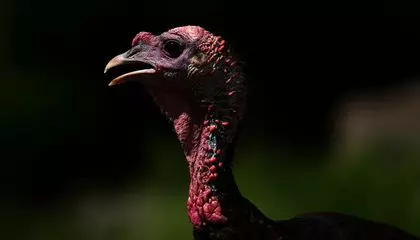
The wild turkey is a noble beast: the muscular, bronze-sheened ancestor of the barnyard turkeys we eat today. While the two technically belong to the same species, the barnyard variety is relatively new on the scene. People began domesticating wild turkeys in what is now Mexico more than 2,000 years ago, selectively breeding them over generations to become fat and docile.
Wild turkeys, meanwhile, have inhabited North America for a much longer time—hundreds of thousands of years. Hunters still eat them, of course, and appreciate the lean gaminess of the wild flesh. But for most of us, the bird is less about sustenance than about a glimpse of the true national temperament: resourceful and restless, by turns noble and idiotic—as liable to swagger into view as to bolt for the trees.
This feathery American character has long invited comparison with another native bird. When the Continental Congress first chose the bald eagle for our fledgling nation’s heraldry, Benjamin Franklin wrote to his daughter in 1784 condemning it as “a bird of bad moral character,” given to stealing food from smaller birds rather than hunting for itself. The choice was in such poor taste, Franklin argued, that even the patently ridiculous turkey would be “a much more respectable bird,” as it was “peculiar” to the Americas.
Though Franklin was teasing the young republic’s taste in civic symbols, the turkey was, in many ways, a perfect pick. It’s one of the few large birds that is unequivocally, evolutionarily American—at home on this continent long before there was a republic to invest it with meaning. With their range stretching across North America, from the desert Southwest to the forested Northeast, wild turkeys have long been prized by Native peoples for their meat and feathers, which were often used in arrow fletchings and ceremonial regalia.
In the Southwest, ancestral Pueblo peoples are thought to have raised turkeys for centuries before using them as a food source. Thanks to Spanish exports from the Americas, eating turkey had already become fashionable in Europe by the time the English got to Jamestown and Plymouth. There, the plentiful wild birds became staples, seen as symbols of the New World’s abundance.
But unregulated hunting and deforestation devastated turkey populations in the United States, which fell from an estimated 10 million to roughly 200,000 by the mid-1930s. Newspapers across the country ran frantic headlines: “Wild Turkeys Nearly Extinct,” the Washington Post declared on December 28, 1905. Fun facts: An anatomical tour of a turkey The fleshy part that extends over (or dangles from) a turkey’s beak is called the snood.
Extract — continue reading at the source.