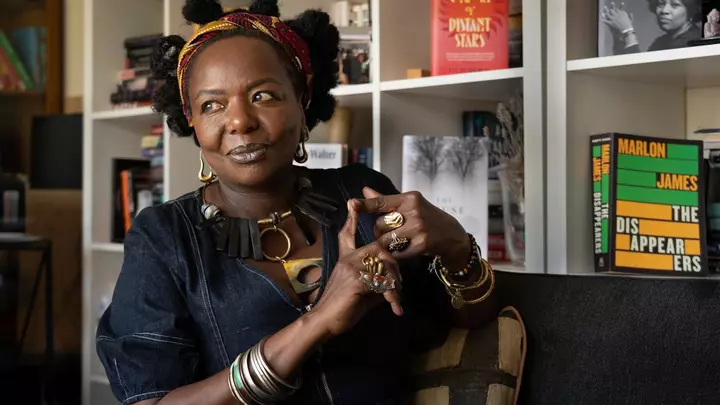
Ellah Wakatama in her study at home in Dollis Hill, London, UK. All photos by James Clarke/Aeon is a writer of fiction and nonfiction from Kisumu, Kenya. He has written for The Atlantic, The New York Review of Books and The Guardian, among others.
Not long ago, a group of East African writers gathered at my house in Nairobi for a writing weekend. We were all working on manuscripts – novels set in Kenya and in Kazakhstan, histories of people in Ethiopia and Uganda, works we each imagined would be our magnum opus – but the problem, invariably, was how we might turn these into published books. Over beers and pizza, we brainstormed.
Maybe what we needed was to be agented in London or in New York. Maybe what we needed was to move to London or New York. Maybe we simply needed to support each other, edit one another’s manuscripts. (But how would that help us get published?) Then, a Somali author who’d won some of Africa’s most important literary prizes for shorter work, chimed in.
What we needed, he said, was to be adopted by Ellah Wakatama. To be an African writer today – especially one writing in English, especially one younger than 40 – is to reckon with the idea of Ellah. Born in Zimbabwe when it was still under the Rhodesian flag, and now based in Britain, she is an editor-at-large at Canongate, an independent publishing firm.
But it is more accurate to describe her as the most powerful woman – person – in Anglophone African literature today. From friends whose books she has touched, one hears of the fury of her red pen, of what they describe as the best editing they’ve ever experienced. From those who’ve worked with her, one hears of a person who doesn’t suffer fools, nor clichés like ‘suffer fools’.
No other individual has so influenced the 21st-century African canon, if there is such a thing. Wakatama calls it ‘the bookshelf that my grandchildren will refer to’. Her lifelong project is to shape that bookshelf, to turn it into a library unto itself.
Extract — continue reading at the source.