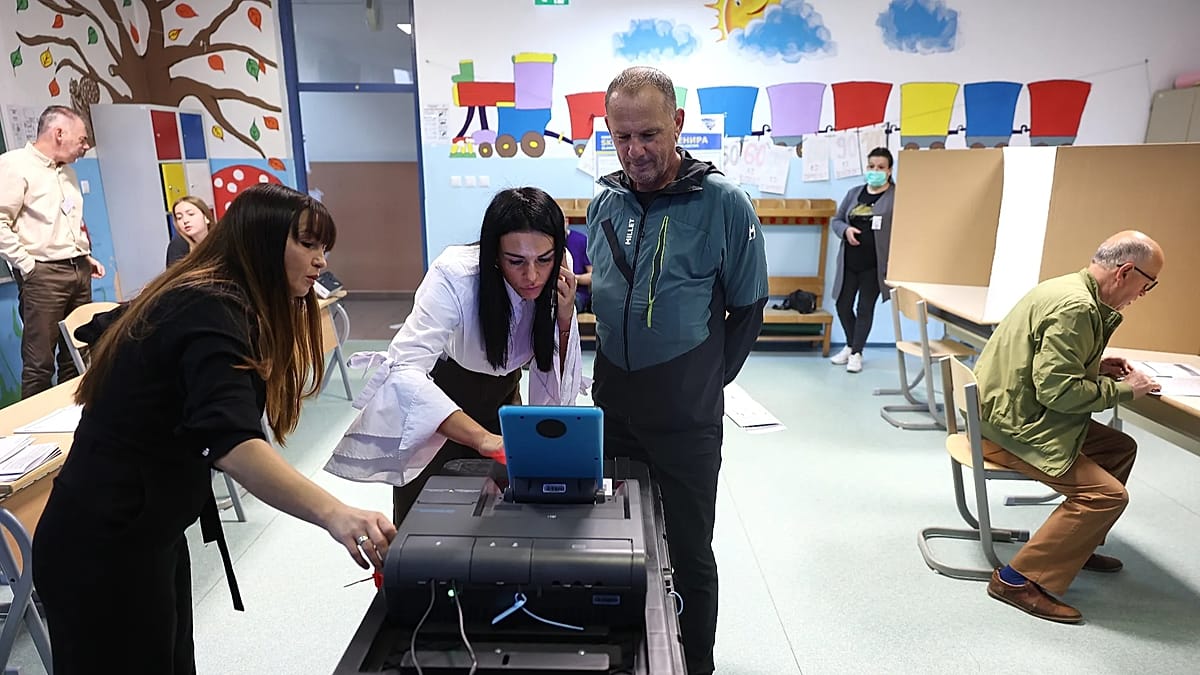
Polls opened Sunday in Bosnia's general election, where some 3.4 million voters are choosing the three members of the multi-ethnic presidency, national lawmakers, and leaders of the country's two entities: the Muslim-majority Federation of Bosnia and Herzegovina and the Serb-dominated Republika Srpska. The complex system of institutions was created by the US-brokered 1995 peace agreement to manage divisions among Muslim Bosniaks, Orthodox Serbs and Catholic Croats. Early reports show voting was delayed at several polling places due to problems with new digital voting technology, which was introduced to address earlier concerns about vote tampering.
Polls close at 7 pm. local time. The election comes as many citizens in the multiethnic Balkan state face everyday problems, while some leading politicians stoke the war-era tensions that have kept the country divided since the 1992-95 conflict. For the first time, authorities are using electronic voter identification and ballot scanning to curb the irregularities and organised manipulation that undermined confidence in earlier elections.
Most of the 75 parties running are organised along ethnic lines. The Bosniak nationalist Party of Democratic Action has campaigned on keeping Bosnia united against Serb separatism, while many Bosnian Croats back ethnic parties such as the local branch of Croatia's ruling Croatian Democratic Union. Izetbegovic, who was beaten by Becirovic in 2022, is seeking a third term as president of the centre-right SDA, the largest Bosniak party in the nation.
Many disillusioned citizens say politicians use nationalism to avoid tackling real problems like low living standards and the exodus of young people. Mostar voter Ivan Silic said nothing has improved since he first voted and that politicians live well while everyone else's situation stays the same. Despite not being on the ballot, the campaign has been dominated by Milorad Dodik, the pro-Russian, separatist former president of Republika Srpska.
Dodik is banned from public office after being convicted of defying the international envoy who oversees the peace agreement. Fresh from meeting Russia's president Vladimir Putin in Moscow, Dodik leads a party, the Alliance of Independent Social Democrats, that is likely to win in Republika Srpska. At a final rally Friday in Banja Luka, attended by Russia's ambassador, Igor Khalabukov, Dodik declared Bosnia is "dead" and "an impossible country".
"It doesn't make any sense," he stressed. Off the ballot for the first time in almost 30 years, he is still in command and is present across the country's media, says Dragan Bursac, an analyst. In Bursac's view, the ban is not working, and Dodik is exploiting it.
Extract — continue reading at the source.