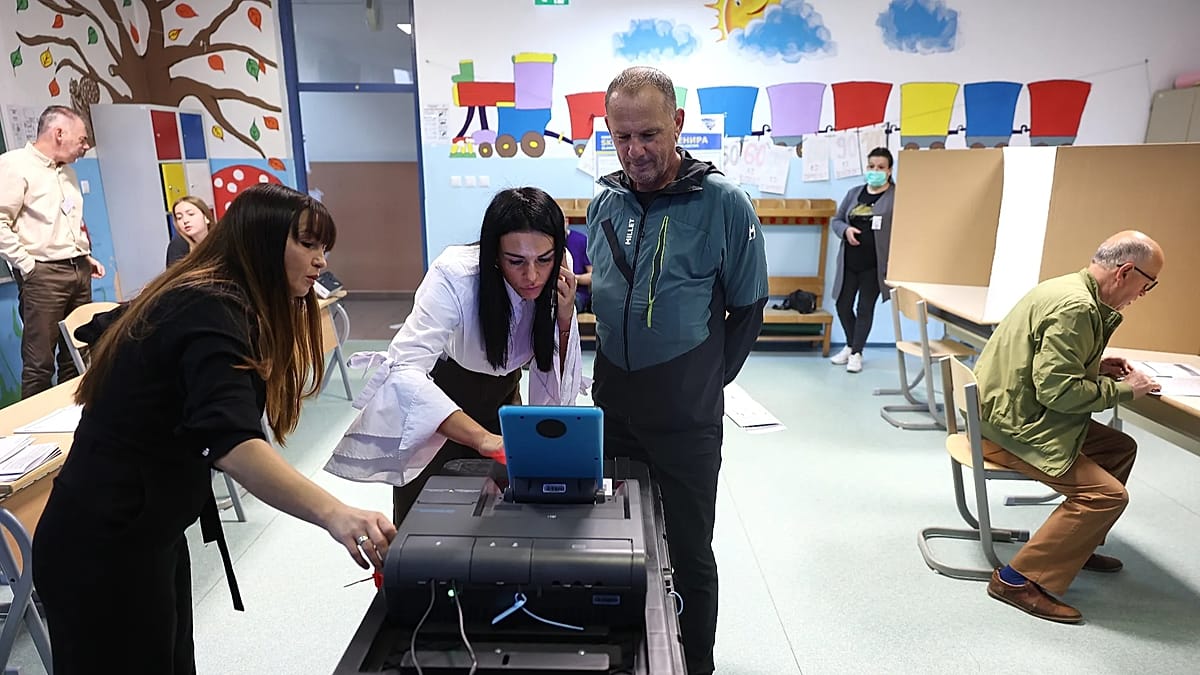
Polls opened Sunday morning in Bosnia and Herzegovinafor a general election in which most citizens of the multi-ethnic Balkan nation are focused on everyday problems, while some mainstream politicians are whipping up war-era tensions that have kept the country divided since its brutal 1992-95 conflict. Around 3.4 million voters in Bosnia are choosing the three members of the country's multi-ethnic presidency, lawmakers for the national Parliament, and heads of institutions for the country's two entities: the Muslim-majority Federation of Bosnia and Herzegovina, and Republika Srpska, which is dominated by ethnic Serbs. Bosnia has a complex web of governing institutions that were created by a US-brokered peace agreement in 1995 in an effort to manage the ethnic divisions between Muslim Bosniaks, Orthodox Serbs and Catholic Croats that gave rise to the war.
To display this content from YouTube, you must enable advertisement tracking and audience measurement. One of your browser extensions seems to be blocking the video player from loading. To watch this content, you may need to disable it on this site.
Cover image: Selma and Danilo are both from Bosnia and Herzegovina, yet ethnic differences mean they have a different version of their country's past. © ENTR On Sunday morning, journalists reported seeing multiple polling places where voting could not begin on time due to difficulties with new digital voting technology, a measure introduced to address earlier concerns over vote tampering. Taking center stage in the contest is a staunchly pro-Russian politician who, despite not appearing on the ballot, has dominated the campaign and inflamed divisions that have sparked fears of renewed instability. Milorad Dodik, the separatist and nationalist former president of the Serb-majority Republika Srpska, has been banned from holding public office after being convicted of defying decisions by the international envoy overseeing the 1995 peace agreement.
Just back from a trip to Moscow where he met with Russian President Vladimir Putin, Dodik's party, the Alliance of Independent Social Democrats, is likely to win the election in Republika Srpska. At his party's final election rally Friday night in Banja Luka, Republika Srpska's administrative capital, Dodik told supporters that Bosnia “is dead". "It is an impossible country.
It doesn’t make any sense,” Dodik said at the rally, which was also attended by the Russian ambassador to Bosnia and Herzegovina, Igor Khalabukov. Dragan Bursac, an analyst, said despite Dodik not appearing on the ballot for the first time in nearly 30 years, he “is still in command. It is obvious that these measures to ban him from political life are not working, and he is using them,” Bursac said.
While Bosnia has been peaceful in recent years, its politicians have kept alive the divisions between the country's Bosniaks, who are mainly Muslim, and its Serbs and Croats. Bosnian Serb leaders like Dodik have pushed for the separation of their entity from the rest of Bosnia, which has led to concerns among Western countries that tensions could once again spill over. Italian prosecutors investigate alleged ‘sniper tourism’ in 1990s Bosnia war To display this content from YouTube, you must enable advertisement tracking and audience measurement.
Extract — continue reading at the source.