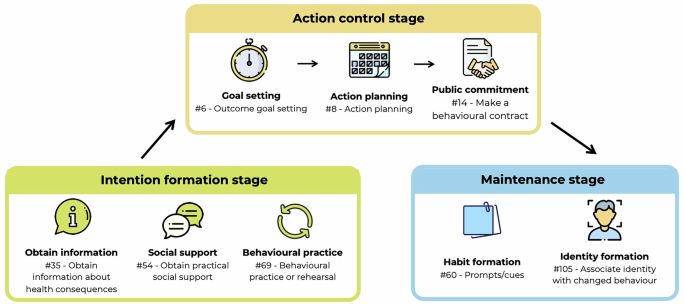
We argue that interventions that empower individuals to manage their behaviour play an important role in physical activity promotion and maintenance. Specifically, we focus on training physically inactive individuals to use self-enactable behaviour change techniques (SE-BCTs) based on the recent SE-BCT compendium. We highlight challenges and potential solutions related to selecting, clustering, sequencing and personalising techniques, particularly when delivered via a digital training platform.
A key challenge in the field of exercise medicine and health is how to support long-term behaviour change, as many important health benefits, such as reduced risks of cardiovascular disease, cancer, type 2 diabetes and other chronic conditions, are contingent on physical activity (PA) sustained over time1. A broad consensus in this field is that PA interventions need to be multi-level, targeting individual, interpersonal, community and policy factors2. Nevertheless, the challenges of implementing and evaluating such interventions are considerable (e.g. need for expertise from multiple disciplines, time and coordination demands, extensive funding and unpredictability3).
In this Perspective, we argue that interventions aiming to empower individuals to manage their self-motivation and behaviour have an important role to play within the PA and public health agenda. Such interventions can strengthen complex multi-level approaches by delivering better outcomes at the individual level and, potentially, by forging stronger synergies across levels (e.g. via technological solutions that can personalise key intervention components and are scalable to the population level). In our Perspective, we focus on the opportunities and challenges involved in training individuals in behavioural skills, in particular, self-enactable behaviour change techniques (SE-BCTs).
We discuss issues of personalisation, clustering and sequencing, as well as how to test their potential effectiveness. Behaviour change techniques (BCTs) have been defined as the active ingredients of interventions designed to change behaviour4. Examples include goal setting, planning, demonstrating the target behaviour and providing feedback on behaviour.
More recently, it has been argued5 that for BCTs to have their intended effects, recipients need to play an active role in enacting them, for example, by successfully adjusting their goals over time. Having an active role is important because the effectiveness of many BCTs may depend on whether recipients understand, practise, adapt and sustain their use6. With this perspective in mind, Knittle and colleagues have published a compendium of self-enactable BCTs (SE-BCTs), defined as actions that individuals must themselves undertake to change their behaviour.
The SE-BCT compendium strengthens attention to enactment fidelity and supports the development of scalable digital approaches that aim to build individuals’ behavioural self-management skills. Many SE-BCTs are already embedded within existing BCT taxonomies and ontologies (e.g. setting goals, self-monitoring) alongside non-SE-BCTs (e.g. demonstration of target behaviour by the intervention deliverer). The compendium5 features 123 SE-BCTs for changing and self-managing one’s motivation and behaviour and is based on the synthesis of six existing BCT taxonomies.
Extract — continue reading at the source.


