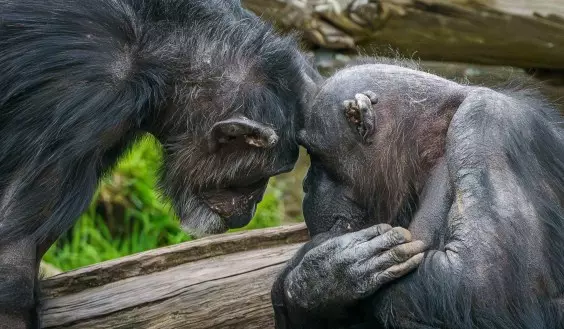
Humans obviously behave differently toward their friends than they do strangers. Case in point: We’re much more likely to loan money to a friend than a stranger. It appears that our closest relatives also differentiate between friends and strangers—especially when it comes to deciding who to steal treats from according to a recent study published in the journal Evolution and Human Behavior.
Experimental psychologists watched 26 adult chimpanzees (Pan troglodytes) during 30-minute feeding times at the Ngamba Island Chimpanzee Sanctuary in Uganda to ascertain which ones were closely bonded via grooming each other, eating together, or otherwise making body contact or hanging out near each other. Next, chimps selected as study subjects were paired with either their closest “friend” or a not-very-close chimp. One chimp (the “victim”) was put in a room with access to three trays baited with large chunks of pineapple.
Another chimp (the “thief”) watched the trays being loaded up, and, after the victim enjoyed one of the pineapple chunks, it was given the opportunity to steal the other pieces of fruit. Read more: “What Became of the Chimps Who Revolutionized Our Understanding of Animal Behavior?” The researchers found that chimps stole more often (in 70 percent of trials) from non-friends than from friends (61 percent of trials). Stomping, screaming, and fist-pounding were taken as measures of negative emotions.
The victims’ initial emotions during a theft were more intense if a friend did the plundering. Across trials, though, the anger against friends diminished, whereas it stayed high with non-friends. The study authors hypothesized that, like humans, chimps have higher expectations of their friends, provoking a stronger reaction at first, but followed by forgiveness and a willingness to share.
They may be the building blocks of our snarkiest behaviors too. Subscribe to our free newsletter. Lead Image: Darwin Brandis / Adobe Stock
Extract — continue reading at the source.