What do “imagineering” and Disney’s Fantasia have in common? The term was officially coined in 1942 by the Aluminum Company of America as a wartime slogan to promote a cross-disciplinary approach to work—combining creative thinking and engineering. Since the 1950s, it has been mostly associated with Walt Disney and the creative process behind Disneyland: designing spaces that conjure strong emotions and create immersion.
The term eventually became a central management paradigm for the company as a whole. One can argue that Fantasia, while not occupying a physical space in the strict sense, qualifies as such because its images and stories introduce layers of signification to sound, adding meaning to and commenting on the music. In doing so, it combines two different disciplines.
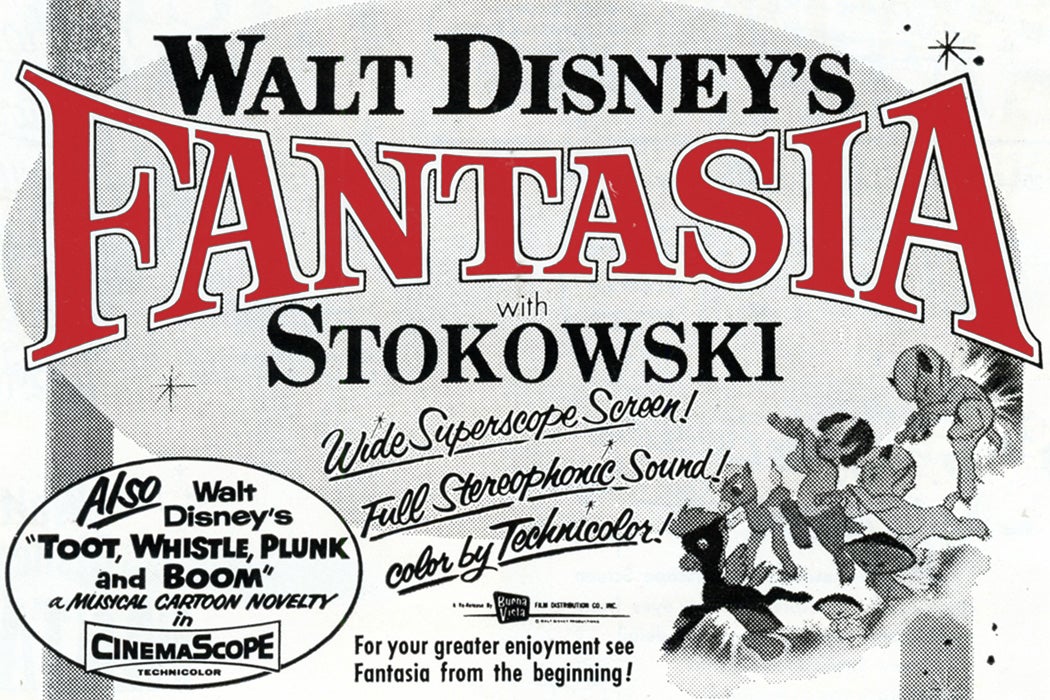
Fantasia, which premiered in 1940, consists of eight animated vignettes, with dozens more pitched but never completed. Each pairs a specific animation style with a piece of music, creating either an audiovisual tableau or a short narrative. The vignettes include abstract and expressionist art set to Bach’s Prelude and Fugue in D Minor, woodland fairies and flowers dancing to Tchaikovsky’s Nutcracker Suite, Mickey Mouse as the Sorcerer’s Apprentice to Dukas’s The Sorcerer’s Apprentice, the history of the creation of the Earth and the evolution of life forms set to Stravinsky’s Rite of Spring, a pastoral Greek landscape populated by centaurs and mythical creatures accompanied by Beethoven’s Pastoral Symphony, anthropomorphic animals engaging in a metaphysical ballet to Dance of the Hours from Ponchielli’s La Gioconda, and Chernabog rousing other demons and the dead accompanied by Mussorgsky’s Night on Bald Mountain.
The film concludes with a procession, drawn in a medieval style, accompanied by Schubert’s Ave Maria. When it premiered in late 1940, Disney’s Fantasia used the latest technology to make classical music more accessible to the general public. The film’s creators assumed that most viewers had little musical knowledge, and that this lack of familiarity could make them more receptive to new ways of understanding music.
And while the intent was to combine the two art forms, music was in the service of animation: the Rite of Spring was spliced, and some sequences were interpolated to serve a plot that charts the evolution of primitive life forms on Earth all the way to the extinction of dinosaurs. Fantasia also exemplifies imagineering in its ideas and values: the aforementioned Rite of Spring, for example, promoted Darwin’s evolutionary theory. A series of vignettes depict stages of prehistoric life from one-cell animals and other early sea life to fishes, mammals, and dinosaurs.” On a less positive note, the film retained many problematic and outdated cultural norms.
Fantasia reflects the ideological viewpoints of its time, drawing on well-established theatrical stock characters, including minstrel-like figures. As a consequence, three characters in the Pastoral Symphony segment—racist caricatures of Black servant girls—were eliminated in the 1969 rerelease of the film. Still, in the same segment, all centaurs and centaurettes pair up based on color, suggesting selective mating and partner choice shaped by the racial attitudes of the 1930s and 1940s.
Extract — continue reading at the source.