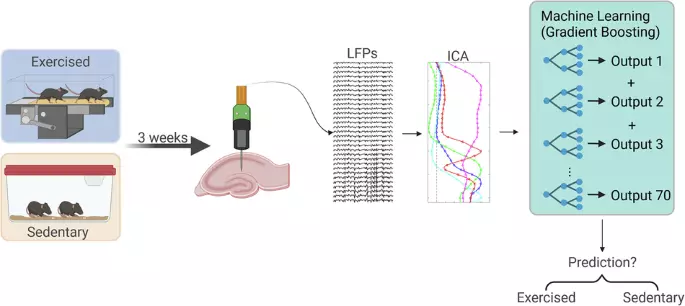
Chronic physical exercise enhances hippocampal function, yet its impact on network activity remains poorly defined. We explored whether treadmill running leaves durable imprints detectable through electrophysiological techniques and spatial transcriptomics. Field potentials (FPs) were recorded in anesthetized male C57BL/6 J mice after a chronic exercise protocol.
Using machine learning to analyze FP generators, we were able to reliably classify animals into their correct group by Lateral Perforant Path (LPP) activity alone. Classification rested on a multifeatured signature rather than any single feature. Schaffer Collateral and Lacunosum-Moleculare generators showed changes that did not achieve statistical significance.
Exploratory spatial transcriptomics identified a coordinated enrichment of calcium signaling and long-term potentiation programs in the dentate gyrus. These findings demonstrate that exercise-induced plasticity is not a global shift but a localized remodeling of specific synaptic inputs, with changes detectable at both circuit and molecular levels. These durable, pathway-specific imprints persist in the absence of active task engagement, suggesting a reorganization of the brain’s memory circuitry.
We are grateful to Laude Garmendia from the Animal House at the Cajal Institute for her invaluable help and advice, and to Jaime Pignatelli, head of the Laboratory of Omics Technologies and Bioinformatics of the Cajal Institute. We also thank Patricia Tezanos for her valuable assistance and insightful ideas throughout this work. Spanish Ministry of Economy and Competitiveness, the Spanish Ministry of Science and Innovation, and the Spanish Ministry of Universities provided predoctoral fellowships, and the Spanish Ministry of Science and Innovation provided grants to support the project (PID2019-110292RB-100 and PID2022-136891NB-I00 -from the Spanish Ministry of Science and Innovation-, to J.L.T.).
No funders had any role in study design, data collection, data analyses, interpretation, or writing of the report. This work was supported by the Spanish Ministerio de Ciencia e Innovación under grant PRE2020/093032 (PM) and CPP2023-010818, MCIU, by CSIC’s excellence programs EU2020/2094-IASOMM24006, by Comunidad Autónoma de Madrid PIPF-2023/SAL-GL-30443 (RMA). These authors contributed equally: Pablo Muela, Julia Makarova.
These authors jointly supervised this work: Oscar Herreras, José Luis Trejo. PhD Program in Neuroscience, Autónoma de Madrid University-Cajal Institute, Madrid, Spain Cajal Neuroscience Center, CSIC, Campus de Alcalá de Henares, Madrid, Spain Pablo Muela, Julia Makarova, Ricardo Muñoz-Arnaiz, Juan B. Aballay, Oscar Herreras & José Luis Trejo APC Microbiome Ireland, University College Cork, Cork, Ireland Department of Anatomy and Neuroscience, University College Cork, Cork, Ireland Correspondence to Pablo Muela or José Luis Trejo.
Extract — continue reading at the source.