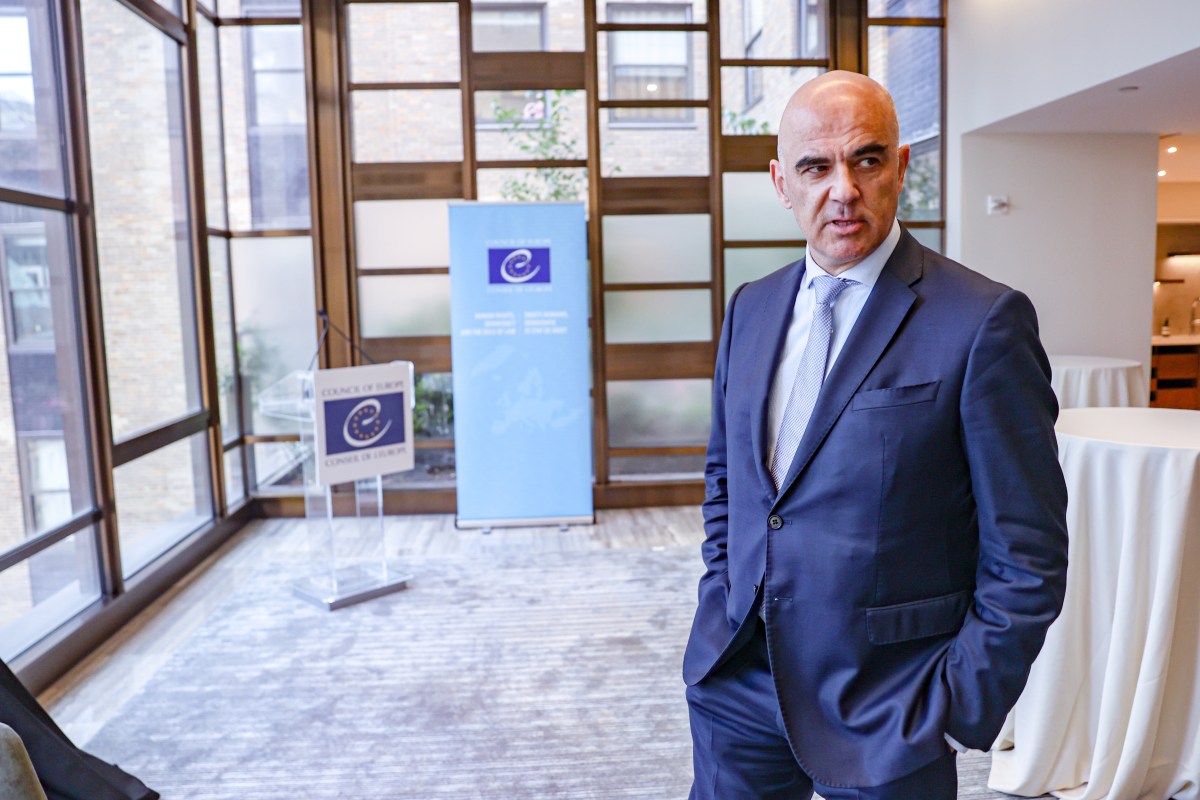
The head of Europe's oldest and largest intergovernmental organization told Newsweek that the continent may not be adequately prepared for the kind of modern, hybrid warfare associated with a potential clash with Russia amid rising tensions. In an interview on the sidelines of the United Nations General Assembly in New York, Council of Europe Secretary-General Alain Berset said that European countries must "evolve to confront, to face, the challenge of hybrid threats." At this time, he said, "we are not really well-prepared for this, to be honest." Berset, a two-time former Swiss president who has served as chief of the 46-member Council of Europe since September 2024, pointed to transformations in the Russia-Ukraine war as an example of how war has changed so drastically in recent years, with tanks and other methods of conventional warfare swapped out for drones capable of carrying out death and destruction at further range, lower cost and far less direct accountability. And the hybrid threat landscape is not limited to the battlefield at a time when not only drones, but also online interference campaigns, have increasingly penetrated across Europe, exploiting a wave of political upheaval that risks upending the liberal consensus.
"It is evolving quite rapidly, and we need to adapt to this," Berset said. "But I think the main point about hybrid threats is not only the drones and the threats while flying over country and so on. The most important thing in this context I think it is about information and about infrastructure and information manipulation and information interference." On this front, he acknowledged "some weaknesses, probably in the energy systems, in the security system, in infrastructure in general." And here, too, he felt Europe was still in the process of catching up.
"And I think maybe we are not well-prepared for this," Berset said. "But it is an evolution." While recognizing the scale of the present challenge, Berset pointed to some clear indications that Europe was on the right track. "On the very short term, I think we are maybe seeing that there is a gap between what is needed and what we have," Berset said.
"But at the same time, if we consider the recent evolutions, let's just say the last two or three years, I mean the institutional evolution is huge. "The decisions, for example, to become much more independent and strong in armament and defense has been taken and it is evolving and it's a good thing." Defense spending among the 27 European Union member states—all of which are also in the Council of Europe—is projected to exceed $516 billion this year, a 75 percent increase from just five years ago. The EU's ReArm Europe Plan/Readiness 2030 campaign also aims to pledge up to $800 billion in additional defense spending.
But there is another budget need Berset identifies to secure the values of human rights, democracy and rule of law for which the Council of Europe has striven since its founding in 1949. "We need the same resolve through the investment for democratic security and democratic values and strong institutions," Berset said. The task is particularly urgent, Berset argued, as while "we are seeing right now strong investments in armies, different armaments" across Europe, "at the same time we are witnessing a strong backsliding in democratic values and the quality of debates everywhere." The risk of this trajectory, he warned, could create a situation in the coming years in which "over-armed countries" have "no democratic control" to restrain them, thus satisfying security needs but lacking the kind of institutions that uphold the Council of Europe's long-standing mission.
The solution he provides is to enhance investment in the combined concept of "democratic security." "It means to have a comprehensive approach where we have democratic institutions in a country able to control what's happening and not having an extremist group winning elections somewhere because of manipulations, or a lot of other reasons, and then taking control of super well-armed armies," Berset said. Yet, already, political forces seeking to undermine the status quo have gained considerable ground across Europe. The most notable example of late is the historic showing by the far-right Alternative for Deutschland (AfD) party in northeastern Germany in this month's state elections, bringing the group to the precipice of obtaining a majority that would empower nationalist forces in the country for the first time since World War II.
Extract — continue reading at the source.