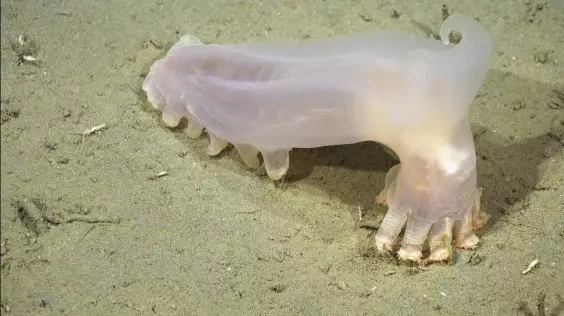
Deep-sea research expeditions are always a good reminder of how little we know about the underwater realm. Case in point: A recent exploration of the Mar del Plata Canyon off the coast of Argentina turned up 57 new marine species and 5 new genera (that’s the grouping above species). Arguably the most fascinating is a critter the research team named Loki the Sea Cucumber, due to its stubby, horned appendages.
This translucent, shimmering blob lives a quiet and unhurried life on the sea floor, sucking up sustenance. To give you some sense of scale, Loki measures about 3.9 inches in length and 1.2 inches in width, so you could pick it up in one hand. The 21-day expedition was undertaken by scientists from the Ocean Census Network and the Schmidt Ocean Institute in August 2025, who used a remotely operated vehicle to dive into the Mar del Plata, which is almost twice the depth of the Grand Canyon.
Despite the darkness at those depths, the canyon is teeming with life. It sits right where warm subtropical currents meet colder waters from the Antarctic, providing a steady supply of nutrients to feed underwater creatures. Besides Loki the Sea Cucumber, the researchers discovered a new species of bamboo coral (no cute nickname, sadly) in the Orstomisis genus.
It stood out because of its vivid, orange-red branches, used to snag passing food. Then there’s a new species of sea pen, the marine animal recovered at the lowest depth the submarine rover explored. If any of these tiny beasties seem familiar, it might be because the original expedition went viral last year.
Livestreams of the underwater explorations averaged around 500,000 views, with a total of 17.5 million views over three weeks. Unfortunately, the expedition also found shoes, plastic bags, and fishing gear, even at these depths—a sobering indication of how far the impacts of human activity reach. Subscribe to our free newsletter.
Lead Image: ROV SuBastian / Schmidt Ocean Institute
Extract — continue reading at the source.