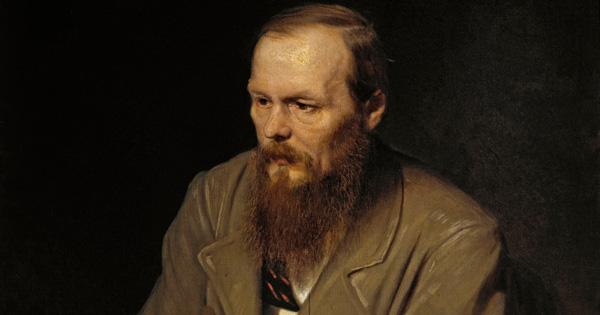
At the age of twenty-seven, he was arrested for belonging to a literary society that circulated books deemed dangerous by the tsarist regime. He was sentenced to death. On December 22, 1849, he was taken to a public square in Saint Petersburg, alongside a handful of other inmates, where they were to be executed as a warning to the masses.
They were read their death sentence, put into their execution attire of white shirts, and allowed to kiss the cross. Ritualistic sabers were broken over their heads. Three at a time, they were stood against the stakes where the execution was to be carried out.
Dostoyevsky, the sixth in line, grew acutely aware that he had only moments to live. And then, at the last minute, a pompous announcement was made that the tsar was pardoning their lives — the whole spectacle had been orchestrated as a cruel publicity stunt to depict the despot as a benevolent ruler. The real sentence was then read: Dostoyevsky was to spend four years in a Siberian labor camp, followed by several years of compulsory military service in the tsar’s armed forces, in exile.
He would be nearly forty by the time he picked up the pen again to resume his literary ambitions. But now, in the raw moments following his close escape from death, he was elated with relief, reborn into a new cherishment of life. He poured his exultation into a stunning letter to his brother Mikhail, penned hours after the staged execution and found in the first volume of the out-of-print collection of his complete correspondence, the 1988 treasure Dostoevsky Letters (public library).
A century before Holocaust survivor Viktor Frankl offered his hard-won assurance that “everything can be taken from a man but one thing: the last of the human freedoms — to choose one’s attitude in any given set of circumstances,” Dostoyevsky writes: Brother! I’m not despondent and I haven’t lost heart. Life is everywhere, life is in us ourselves, not outside.
There will be people by my side, and to be a human being among people and to remain one forever, no matter in what circumstances, not to grow despondent and not to lose heart — that’s what life is all about, that’s its task. I have come to recognize that. The idea has entered my flesh and blood… The head that created, lived the higher life of art, that recognized and grew accustomed to the higher demands of the spirit, that head has already been cut from my shoulders… But there remain in me a heart and the same flesh and blood that can also love, and suffer, and pity, and remember, and that’s life, too!
Extract — continue reading at the source.