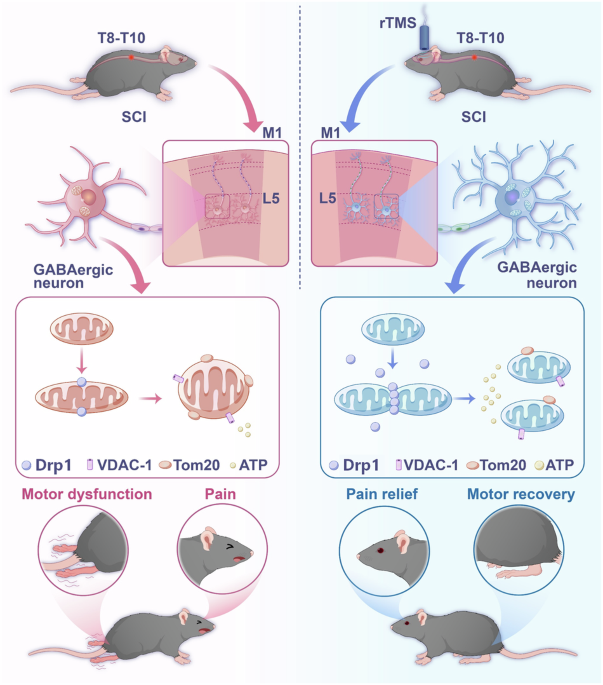
Spinal cord injury (SCI) leads to chronic motor and sensory deficits, with progressive secondary neurodegeneration posing a major therapeutic challenge. Although high-frequency repetitive transcranial magnetic stimulation (HF-rTMS) over the primary motor cortex (M1) shows therapeutic potential, its underlying cellular mechanisms remain poorly understood. This translational study first demonstrated that HF-rTMS concurrently improved motor function and alleviated neuropathic pain in retrospective clinical cohorts and a validated murine SCI model.
To decipher the supraspinal mechanism, we used an integrated approach combining behavioral analyses, transmission electron microscopy and single-nucleus RNA sequencing. Transcriptomics revealed that HF-rTMS specifically rescued SCI-induced disruptions in oxidative phosphorylation and mitochondrial energy metabolism pathways within M1 GABAergic neurons. Here we pinpointed a key molecular lesion: SCI selectively downregulated the mitochondrial fission regulator Drp1 in M1 layer V GABAergic neurons, leading to dysfunctional mitochondrial dynamics and bioenergetic deficits.
HF-rTMS restored Drp1 levels and mitochondrial ultrastructure specifically in M1 but not in the primary somatosensory cortex, underscoring its region-selective action. Most importantly, functional causality was established: Drp1 overexpression in M1 GABAergic neurons mimicked the therapeutic benefits of HF-rTMS, whereas Drp1 knockdown or its pharmacological inhibition completely abolished these effects. Our findings establish impaired mitochondrial dynamics in a specific cortical microcircuit as a convergent driver of multisystem deficits post SCI, and identify Drp1 as a pivotal molecular target of HF-rTMS.
This work provides a novel mechanistic foundation for Drp1-directed precision therapies, highlighting the potential of rescuing cortical mitochondrial bioenergetics to halt progressive secondary damage and improve functional recovery after central nervous system injury. Spinal cord injury (SCI) is a debilitating condition characterized by extensive secondary neurodegeneration that predominantly affects young and middle-aged adults, imposing severe socioeconomic consequences due to its high prevalence during peak productive years1. A previous study demonstrated that nearly all patients with complete SCI and the majority with incomplete SCI experience motor deficits2, and estimates suggest that 68% of patients with SCI suffer neuropathic pain (NP)3, both of which substantially reduce quality of life.
Although a spontaneous repair mechanism exists after SCI, complete neurologic recovery is exceptionally uncommon, occurring in
Extract — continue reading at the source.