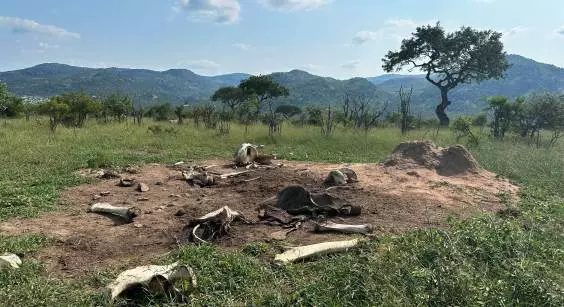
They trample trees, loosen soil with their tusks, and can even create trails and watering holes. According to a new study published in the Proceedings of the National Academy of Sciences, these massive beasts continue to sculpt the savannas long after their deaths. To investigate the impact of elephant carcasses on the ecosystems, biologists from the University of California, Santa Barbara spent nearly eight years sampling the soil and plant life from 40 different carcass sites scattered throughout South Africa’s Kruger National Park.
Read more: “Is Poaching Causing Elephants to Evolve Without Tusks?” “My intuition was that, since the carcass was only physically present for a relatively short period, its effect would also be rather muted and transient,” study co-author Izak Smit of the South African National Parks said in a statement. First, nutrients from the elephant corpses leached into the ground, altering soil chemistry with nitrogen levels spiking dramatically. With a colossal influx of nutrients, bacteria rapidly proliferated—but only a few species.
According to the team, a handful of fast-growing bacteria likely out-competed the rest, resulting in a dearth of microbial diversity. After soil nitrogen levels settled down a bit, plants started to grow, but the researchers found they followed the same pattern as the microbes, with just a few species dominating the carcass site (mostly grasses). According to the team, the nutrient hot spot resulted in a biodiversity cold spot, a dynamic that was present throughout the nearly eight-year study period.
Analysis of the plant leaves also revealed they contained more nutrients. These lush grasses provided food for grazing herbivores for years, and their droppings kept the sites fertilized. It’s a lot of ecological activity from just 40 elephant carcasses, and per the team, around 600 elephants die in the preserve each year.
Of course, tens of thousands of years ago when megafauna were plentiful, this particular ecological cycle would have been more common. Now elephants are among just a few species of massive animals left, and they’re also endangered. Subscribe to our free newsletter.
Extract — continue reading at the source.