In 1824, studying a set of large fossil bones discovered in a quarry near Oxford two centuries earlier, the English theologian, geologist, and paleontologist William Buckland kept looking at the fragment of the lower jaw. As he examined it more closely, he realized these were not the remains of an elephant, as previously thought, but of an enormous carnivorous reptile with no analogue in the fossil record or in the living world. He christened it Megalosaurus — the first named dinosaur — and set out to compose a complete account of the ancient beast.
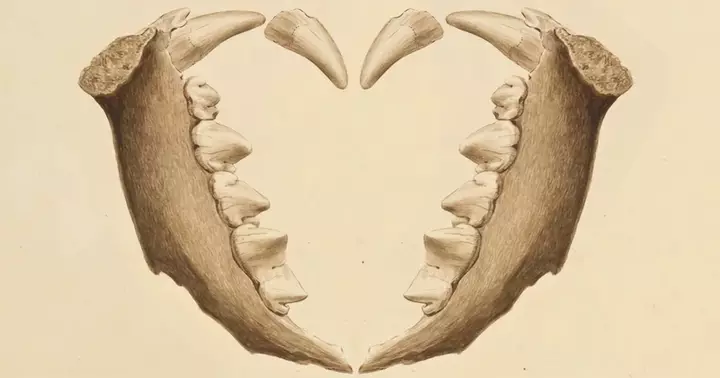
Because nobody knew what dinosaurs looked like, he needed an exceptional scientific illustrator whose unbridled imagination and disciplined draughtsmanship could enflesh the bones of the mysterious creature. Taken by a particularly excellent drawing of the jaw of an extinct hyena, he obtained a letter of introduction to the artist, tucked it into his coat pocket, and boarded a coach across Devonshire, hoping to be received. William took one book to accompany him on the long ride — a weighty new volume by paleontology founding father Georges Couvier, summarizing his pioneering research on the fossil bones of quadrupeds.
With gaping disbelief, he watched another passenger take out that same book and begin paging through it. The conversation was inevitable and the realization quick: She was the artist he was traveling to meet. Cuvier himself had sent her the book in gratitude for her contribution.
Perhaps because she had lost her mother while still an infant, Mary Morland had grown up fascinated by deep time, by the slow-burning beauty of minerals, by the way fossils immortalized the ephemerality of the flesh. After devouring Couvier’s books as a teenager, she taught herself draughtsmanship and unlearned what her culture had told her she could be: Determined to become an artist of science, she sent her specimen illustrations to Couvier himself. The venerable scientist was so taken with the young woman’s work that he published it alongside his studies.
Word spread across the scientific community and soon she was illustrating other books and modeling rare specimens in leather. Unlike most women of her time, whose standard path to subsistence was marriage, Mary could now make a living by her own work. If she married, it would only be for love.
Her love was the science of time: She kept drawing paleontological specimens, grew an impressive mineral collection, became a fossil geologist herself. By the time she met William that day on the coach, she was an old maid in her late twenties and one of the era’s most esteemed scientific illustrators. They started on the dinosaur work immediately.
Extract — continue reading at the source.