Vestibular schwannoma (VS) is the most common benign tumor in the cerebellopontine angle, with approximately 95% of patients suffering sensorineural hearing loss (SNHL). Ferroptosis, an iron-dependent form of regulated cell death driven by lipid peroxidation, has been implicated in cochlear hair cell vulnerability. However, its role in VS-associated SNHL remains poorly understood.
In this study, we investigated whether VS-derived exosomes (VS-Exos) contribute to SNHL by inducing ferroptosis in cochlear hair cells. Proteomic and bioinformatic analyses were performed to compare exosomes from VS patients with poor hearing (PH-Exos) versus those with good hearing (GH-Exos). In vitro and in vivo experiments were conducted to assess the damaging effects of VS-Exos on cochlear hair cells and to evaluate the protective effect of the ferroptosis inhibitor ferrostatin-1 (Fer-1).
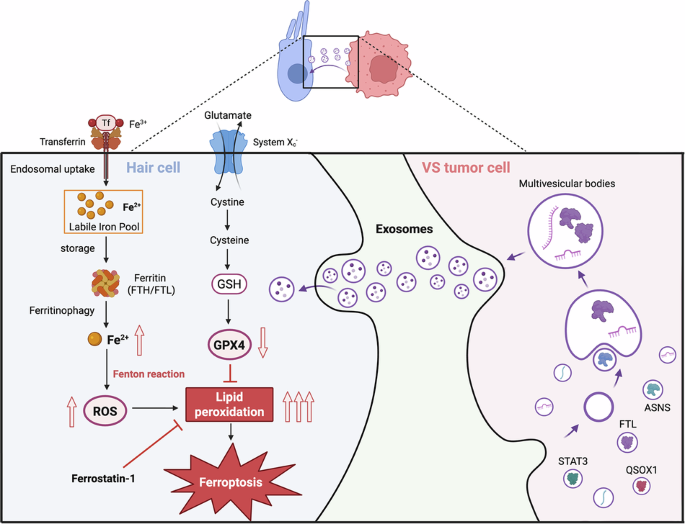
Our results demonstrate that VS-Exos promote ferroptosis in cochlear hair cells by downregulating glutathione peroxidase 4 (GPX4) and disrupting iron homeostasis, leading to accumulation of ferrous ions, reactive oxygen species, and lipid peroxidation. Notably, PH-Exos induced significantly greater ferroptotic damage than GH-Exos. Treatment with Fer-1 effectively alleviated hair cell injury and preserved auditory function in vivo.
These findings uncover a novel mechanism by which VS-Exos contribute to hearing loss through GPX4 suppression and iron dyshomeostasis, and suggest that targeting ferroptosis or exosome-mediated signaling may represent a promising therapeutic strategy for hearing preservation in VS. We acknowledge all the patients for their contribution to this study. The graphical abstract, along with all flow charts and schematic diagrams in this article, was created using BioRender.com.
This work was supported by the National Natural Science Foundation of China [grant no. 81870712, 8257040660 to Z.Z.], Two-hundred Talent project of Shanghai Jiao Tong University [grant no. 20191913 to Z.Z.], Biobank Project of Shanghai Ninth People’s Hospital [grant no. YBKB202215 to Z.Z.], Natural Science Foundation of Shanghai Municipality [grant no. 24ZR1442700 to Z.H.] and Shanghai Key Laboratory of Translational Medicine on Ear and Nose Diseases [grant no. 14DZ2260300 to H.W.]. These authors contributed equally: Dilihumaer Maimaitiming, Yuewen Gao.
Department of Otolaryngology Head and Neck Surgery, Shanghai Ninth People’s Hospital, Shanghai Jiao Tong University School of Medicine, Shanghai, China Dilihumaer Maimaitiming, Yuewen Gao, Zhaohui Wang, Tao Yang, Hao Wu, Zirong Huo & Zhihua Zhang Ear Institute, Shanghai Jiao Tong University School of Medicine, Shanghai, China Shanghai Key Laboratory of Translational Medicine on Ear and Nose Diseases, Shanghai, China Correspondence to Zirong Huo or Zhihua Zhang. The authors declare no competing interests. Informed consent was obtained from all subjects involved in the study.
Extract — continue reading at the source.