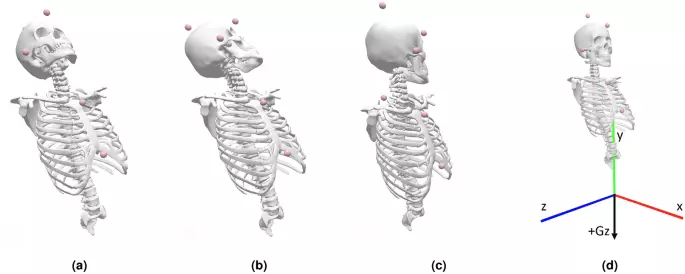
The cervical spine of fast jet pilots is exposed to high +Gz accelerations during large range of head movements which may lead to biomechanical impairments. The objective of this study therefore was to quantify and analyze the resulting external cervical spine joint moments experienced by fast jet pilots during standardized head movements in real–flight during +5Gz, +7Gz and +9Gz maneuvers. The in– flight helmet orientation recordings and additional ground based motion capture recordings of isolated head movements of seven Eurofighter pilots were processed using a custom made pipeline.
Subsequent inverse kinematics and inverse dynamics simulations of the in–flight head movements using individual OpenSim pilot models showed a significant reduction in the head extension angle with increasing +Gz acceleration. Cervical spine joint moments did not change significantly with increasing +Gz acceleration. However, theory–based model analysis indicated that constant head positions under higher +Gz acceleration would lead to an increase in joint moments.
The pilots seemed to exhibit reduced head extension at higher +Gz levels, while external joint moments remained relatively constant. Furthermore, the designed pipeline may support individual cervical spine health assessment and monitoring, as well as to inform strength training or rehabilitation programming. Pilots flying jets capable of high +Gz maneuvers can be exposed to extreme physical demands1 and commonly experience neck pain and injury due to the unique demands of high +Gz acceleration flight2,3,4,5.
Especially pilots flying high–performance military jets during highly dynamic flight maneuvers must not only absorb and process the information presented in the cockpit, but also scan their surroundings, even in high +Gz conditions, performing distinct large–scale head movements1,6,7. In fact, a systematic review reported that the ’check six’ movement, which is looking back over the shoulder, was the most common posture associated with neck pain in fighter pilots and that high +Gz pilots have a higher prevalence of neck pain than low +Gz aircrew3,4,8. Gathering information by head check movements is necessary for optimal pilot performance and decision–making, particularly during highly dynamic interactions of two or more jets6,7.
Maintaining operational readiness and capabilities under such extreme conditions requires physical health, and therefore an understanding of the stresses that occur up to the +9Gz limit set by the flight control system without implying an intentional overstepping. Higher +Gz accelerations, included in simulations using OpenSim models, resulted in increased moments and forces1,9,10. Adding to these challenges, modern helmet systems increase head mass and shift its center of gravity forward.
Biomechanical modeling shows that heavier helmets markedly increase cervical spine joint moments1,9 and compression forces11. Furthermore, previous studies suggest that high +Gz accelerations increase neck strain, which can lead to short–term and long–term cervical spine disorders which may lead to injuries12,13,14. Possible identified risk factors are, among others, cumulative exposure to high +Gz accelerations and rotated head positions under high +Gz accelerations12,13,14.
Extract — continue reading at the source.