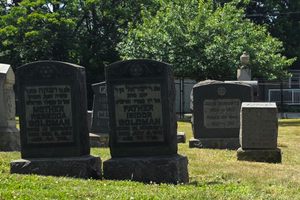
All the United States Ohio Cleveland Fir Street Cemetery The second oldest Jewish cemetery in Cleveland was, despite its diminutive size, originally three separate burial grounds. Where the east-west orientation of the Hungarian Cemetery (left) meets the Anshe Emeth Cemetery. Anna Minster / Atlas Obscura User The gravestones of Aaron (left) and Phil Horwitz.
Anna Minster / Atlas Obscura User The marker for Harry and Sarah Bernstein. Anna Minster / Atlas Obscura User The cemetery is usually locked. Anna Minster / Atlas Obscura User Modern Fir Street Cemetery sign.
Anna Minster / Atlas Obscura User The Fir Street Cemetery (partial view). Anna Minster / Atlas Obscura User Where the east-west orientation of the Hungarian Cemetery (left) meets the Anshe Emeth Cemetery. Anna Minster / Atlas Obscura User In the mid-nineteenth century, farmland west of Cleveland was purchased by real estate speculators and subdivided for development.
The Fir Street Cemetery, as it is currently known, occupies just eight residential lots in what first became Brooklyn Township and is now incorporated within Cleveland. In spite of its small size, the burial ground is historically three separate graveyards. The oldest portion of the cemetery is the middle 3.5 lots purchased by the Hungarian Aid Society, established to assist Jewish émigrés in need, including with burial.
The lots to the east were bought by the Chevra Kadisha Society and Anshe Emeth, historically the largest and oldest orthodox synagogue in Cleveland, acquired the lots on the west side of the block. By the early-1900s, most of the graveyard was known informally as the Hungarian Cemetery, with the western section retaining its identity as the Anshe Emeth Cemetery. The first burial, in 1865, was that of Aaron Horwitz, the two- or three-year-old son of James (née Jacob) Horwitz, who received his medical degree from the University of Vienna, and Fannie Horwitz.
Horwitz was a supporter of the 1848 Hungarian War of Independence and fled Galicia when the revolution failed. Surprisingly, given the small size of the Fir Street Cemetery, the last burials didn’t occur until 1971. By then, the geographic center of the Jewish community had moved eastward and over time, the graveyard deteriorated, in part due to vandalism.
Extract — continue reading at the source.



/https://tf-cmsv2-smithsonianmag-media.s3.amazonaws.com/filer_public/55/9c/559c3e43-f760-48c8-978b-1faec1bf964e/nobel-chem.jpg)