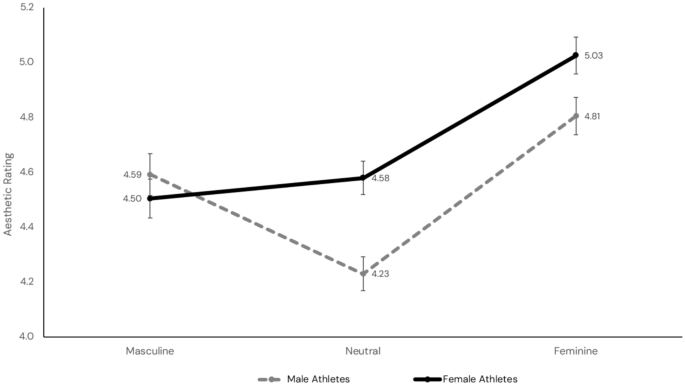
Despite increasing visibility of women in sport, athletes are often evaluated relative to gendered expectations that may shape how their performances are perceived. The present study examined whether aesthetic evaluations of sport movements differ systematically as a function of athlete sex and sport gender-typing. Drawing on processing fluency theory, we tested whether performances that align with gendered prototypes are evaluated differently than those that deviate from them.
A total of 117 participants first categorized 15 sports as masculine, feminine, or gender-neutral and subsequently evaluated 60 video clips showing female and male athletes performing prototypical movements. In addition to rating aesthetic appeal, participants completed a forced-choice task selecting the most aesthetically pleasing performance within each sport. Aesthetic evaluations varied as a function of athlete sex and sport gender-typing.
Movements performed by female athletes received higher aesthetic ratings in feminine and neutral sports, whereas no significant differences in aesthetic ratings emerged in masculine sports. Forced-choice judgments showed stronger alignment with gender-typical expectations, favoring male athletes in masculine sports. These findings suggest that aesthetic evaluations of sport movements vary by athlete sex and sport gender-typing, although the mechanisms underlying these differences remain to be established.
Humans derive aesthetic appreciation from a diverse array of sources, including the performing arts, music, literature, architecture, faces, landscapes, and many everyday objects1. Aesthetics also plays a central role in sports, where social dynamics, observer perceptions, and the athlete's physical performance blend and create a unique context for aesthetic experience. While aesthetic judgments have been studied extensively in traditionally aesthetic disciplines such as dance or gymnastics, less is known about how aesthetic evaluations emerge across different types of sports (e.g., soccer or tennis), for instance those where aesthetic qualities are not directly tied to performance outcomes (e.g., scoring or speed)2.
In particular, little attention has been paid to the social factors that may shape such judgments. The present study addresses this gap by examining factors that shape the aesthetic perception of different sport movements, with a particular focus on prototypicality and gendered expectations. Despite increasing visibility and participation of women in sport, research on sport perception and performance remains disproportionately centered on male athletes36.
This imbalance contributes to a male-default standard, in which athletic performance is implicitly defined based on male bodies, movements, and styles of play. As a consequence, female athletes are often evaluated relative to norms that do not reflect their own embodied characteristics. Such biases may shape not only judgments of performance quality but also the aesthetic evaluation of sport movements, thereby contributing to systematic differences in how female athletes are perceived, valued, and represented.
Extract — continue reading at the source.