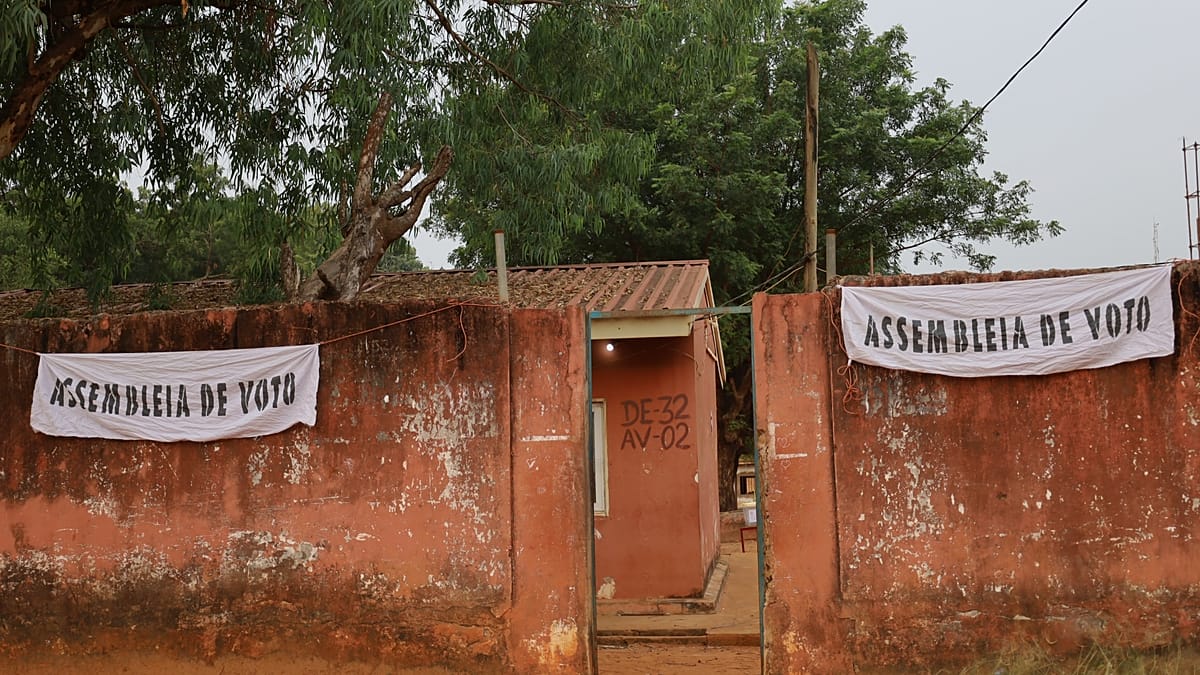
Military-run Guinea-Bissau will hold a referendum on Sunday on a constitutional change that would give the president more powers ahead of a general election meant to restore civilian rule later this year. This new constitution was presented by transitional, unelected bodies that emerged from the military coup d’état last November. Bubacar Turé, who heads the Guinean League for Human Rights, told Euronews that at this stage, only the "yes" camp is running an official campaign and is doing so "in all regions." "There is a campaign under way led by the military, their political supporters and also some senior figures from the previous regime, who are likewise associated with the transition now in force," he explains.
Turé points out that advocates of a "no" vote are not authorised to campaign, at a time when "several freedoms are suspended." "The climate is not favourable, it is not a climate of freedom," he concludes, adding that the opposition is issuing a call to boycott. "There is also a strong appeal for a boycott, not only from political parties but also from civil-society organisations." The main opposition party, the historic African Party for the Independence of Guinea and Cape Verde (PAIGC), is likewise calling for a boycott. The PAIGC says the referendum is "a staging meant to give the appearance of legitimacy to the new constitution" and that the institutions that arose from the coup d’état are "devoid of any democratic legitimacy." In its decision, the party also notes that the authorities are preventing the "no" side from campaigning.
All this, it says, is happening in "a context of severe restrictions on public freedoms," with political activity suspended. In an interview with RTP, the PAIGC leader called the referendum an "absolute farce." Domingos Simões Pereira even said that "what will happen on 30 August is the continuation of the coup d’état carried out on 26 November." But the transitional authorities defend the document. In an interview with RFI, the second vice-president of the Transitional Council, the body replacing parliament, Nelson Moreira, said that the current constitution has often been cited as "the cause of instability in Guinea" and that "through the High Military Command it was possible to turn that dream into reality." Nelson Moreira also defended the legitimacy of the process.
Bubacar Turé says the text being put to a vote entails "an excessive concentration of powers in the hands of the president of the republic." The president will chair the Council of Ministers and while the post of prime minister remains, there is now new wording on how the holder is appointed. "In the previous constitution, the requirement for appointing the prime minister was based on the election results," says the human-rights activist. "This new constitution, however, adds the existence or not of a parliamentary majority that guarantees stability." "This opens up the possibility that legislative elections will have no meaning at all." The activist also points out that the chapter on constitutional review has been removed.
"This constitutional revision has done away with that chapter, which is absurd, strange and extremely dangerous for the rule of law and for democracy," says Turé. The way the process unfolded also draws sharp criticism from Bubacar Turé. "No one was consulted – not political parties, not civil-society organisations, let alone traditional leaders, religious leaders, and so on.
Everything was done in secret." He also notes that the constitutional text itself has already been published in the Official Gazette. "What legal effect can this referendum have if the constitution is already in force, since it has already been approved, promulgated and is in force in Guinea-Bissau?" he asks. Tamilton Teixeira is a university professor and commentator on various Guinean media outlets and on RTP África.
Extract — continue reading at the source.