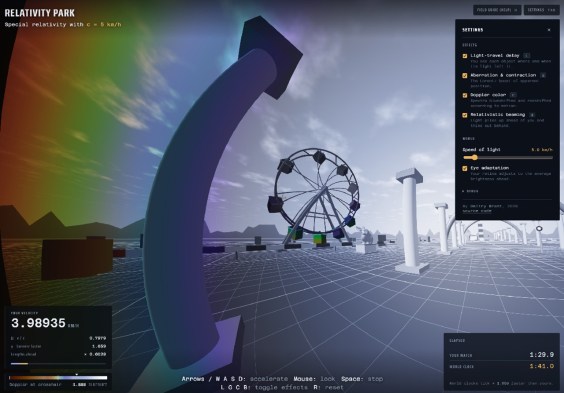
Day to day, most of us don’t give much thought to the fundamental fact of physics that light is traveling across the universe at nearly 671 million miles per hour. But a new simulator asks a fun question: How would the universe appear if light moved at a much, much slower speed? A new web project called Relativity Park from developer Dmitry Brant lets us explore a world where the speed of light is set at 3.11 miles per hour, or a brisk walking pace.
At this speed, the rules set down by Einstein’s 1905 theory of special relativity start to become much more obvious, with some mind-bending and eye-popping results. To summarize his theory: The speed of light is fixed, no matter if you’re standing still or traveling close to the speed of light yourself. That means, as your own observing speed changes, the speed of light does not.
Instead, time and space have to begin distorting themselves to compensate. In reality, you’re never going to get anywhere close to the speed of light, whether you’re on a rocket launcher or strolling down the road, so these space and time warps are imperceptible (though astronauts on the ISS do age fractions of a second slower). Step into Relativity Park, however, and these distortions show up quite noticeably.
Read more: “5 Amazing New Discoveries About Light” All the instructions you need are on screen, but try holding down the up arrow or the W key for a second or two. This speeds up your pace, getting closer to the (slow) speed of light. Everything in front of you bunches together (relativistic aberration) and gets shifted toward the color blue (Doppler color).
Use the mouse to turn around, and the scenery is stretched out and redder, as this is away from your direction of travel—the same effects, but opposite. You’ll also notice brighter colors ahead of you (light piling up) and darker colors behind you (light thinning out). Occasionally, an object will appear bright in a dark area, which is the counteraction of its own motion, relative to the speed of light.
Keep an eye on the stopwatch in the bottom right corner too, which shows time as you’re experiencing it, and the time in the world around you. Look at the flashing lampposts as well—their timing and color doesn’t change, but your perspective will as you speed up or slow down. Subscribe to our free newsletter.
Extract — continue reading at the source.