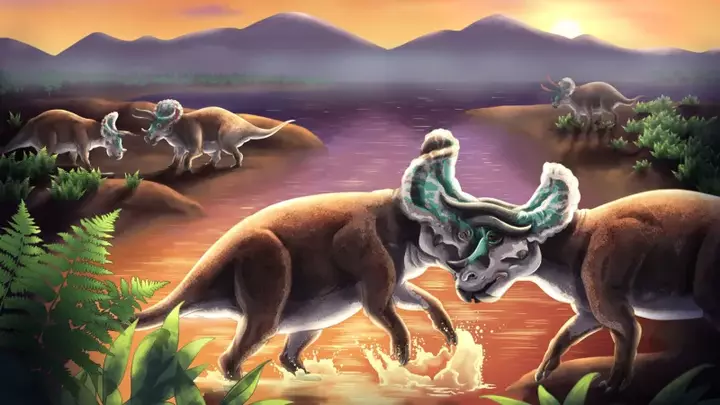
Triceratops’ massive skulls were built for horn-to-horn grappling. The rhino-like Centrosaurus could withstand stabbing its nose horn up and down. And the parrot-faced Psittacosaurus would have been wise to avoid a fight: Its head was ill-suited to handle blows.
New simulations using 3-D models of the heads of five different horned dinosaurs reveal what forces the skulls could withstand in battle. The results provide insight into how these dinosaurs evolved to use their face-based armory in combat, researchers report September 24 in PeerJ. Ceratopsians — horned dinosaurs like Triceratops — have been hypothesized to use their imposing headgear as armaments for battling with other members of the species.Fossilized facial injuries consistent with head-to-head violence have provided physical clues.
Alf Museum of Paleontology in Claremont, California. But little else was known about how ceratopsians actually used their horns in battle. Studying the biomechanics of the animals’ weaponized skulls could provide information on what movements and forces the dinosaurs evolved to tolerate.
Such biomechanics research had previously been done on the bite stresses of theropod dinosaurs like Tyrannosaurus and on the forces felt by the club tails of armored dinosaurs, says vertebrate paleontologist Eric Austin Ames Jr. Ames and his colleagues at the University of Bristol in England developed digital 3-D models of six skulls across five ceratopsian species spread across the group’s evolutionary tree. They simulated the combat stress experienced across the skull, varying the direction of attack and how the weaponry was used.
Higher stresses in the skull meant a greater risk of mechanical failure, Ames says. The dinosaurs are more likely to have evolved to fight in a way that was well-tolerated by the skull’s mechanics. The team found that early members of the group from about 125 million years ago — like the hornless, husky-sized Psittacosaurus — didn’t have skulls well-suited for combat of any type.
The pig-sized Protoceratops had a skull that tolerated ramming fairly well. Larger, later-diverging species like Centrosaurus and the three-horned Triceratops and Spiclypeus appeared adapted to a wider range of combat styles. Centrosaurus may have been a specialized stabber, lunging its head to jab at opponents.
Extract — continue reading at the source.