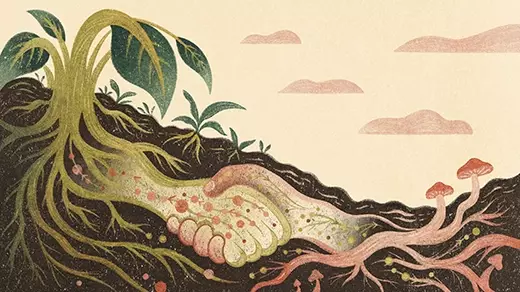
People may think of soil as just dirt, but it is anything but inert. Beneath your feet, a vast network of mycorrhizal fungi is hard at work, trading minerals with plant roots. This trading system helps enrich the soil, and it sequesters 13 billion tons of atmospheric carbon dioxide each year — roughly equivalent to one-third of the world’s fossil-fuel emissions.
Scientists know that these fungi form partnerships with 80% of all plant species on Earth, a relationship that evolved some 450 million years ago. What they have not understood is how organisms with no brain or central nervous system can decide whom to trade with, and on what terms. Toby Kiers, an evolutionary biologist at Vrije Universiteit Amsterdam, has spent much of her career making this hidden world visible.
Drawing on economics and game theory, and using tools that range from fluorescent quantum dots to imaging robots, her lab is probing how fungi and plants conduct their trade. The work raises new questions about soil, carbon, and even what counts as an individual organism. In this episode, Kiers tells co-host Steven Strogatz how these brainless, decentralized organisms can behave strategically — discriminating between better and worse partners and shifting resources across the network to wherever a plant will “pay” more for it — and how she has built a worldwide community of researchers to map the biodiversity of these underground networks and advocate for their protection.
Listen on Apple Podcasts, Spotify, TuneIn or your favorite podcasting app, or you can stream it from Quanta. LEVIN: A podcast from Quanta Magazine where we explore some of the biggest unanswered questions in math and science today. STROGATZ: Hey there, Janna.
I would love to talk to you about a big question. STROGATZ: Imagine you’re walking around in the forest or in Central Park. STROGATZ: I know, so what’s under your feet?
What are your shoes hitting? LEVIN: I think people would be very surprised that there’s real nature in Central Park. So you got the grass, you got the trees.
Extract — continue reading at the source.