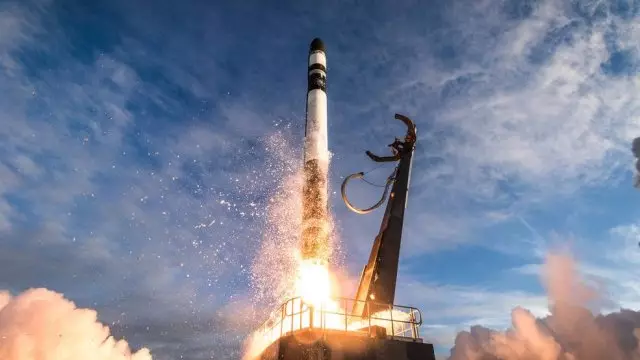
If a spaceship constantly accelerated at that rate, here's how far we could travel. This photograph shows the 2018 launch of Rocket Lab's Electron rocket lifting off from Launch Complex 1 in New Zealand. Rockets convert fuel into energy and thrust, expelling it and losing mass as they accelerate.
As a result, F = ma is too oversimplified to be used to calculate a rocket's acceleration, but the largest and most powerful modern rockets can still only sustain their accelerations for up to 8-10 minutes. Here on Earth, we constantly experience Earth’s gravity: 1 g, or 9.8 m/s². This image shows a person in free-fall close to Earth’s surface.
They still accelerate toward the center of the Earth at 1g, but have no normal force acting on them. As a result, for the brief moments from when this photo is taken until they hit the water, they effectively experience weightlessness. Astronauts only experience weightlessness once their rocket’s thrusters cease.
Shown here, two astronauts experiencing weightlessness aboard the International Space Station demonstrate, together, the conservation of angular momentum. A consequence of the symmetry of rotational invariance, the astronaut spins faster only because a torque is applied to him from another astronaut’s body. The amount of angular momentum transferred to the spinning astronaut is canceled out by the equal-and-opposite amount of angular momentum transferred back into the other astronaut-ISS system.
As long as there’s acceleration, an astronaut’s experience is indistinguishable from gravity. The identical behavior of a ball falling to the floor in an accelerated rocket (left) and on Earth (right) is a demonstration of Einstein’s equivalence principle. If inertial mass and gravitational mass are identical, there will be no difference between these two scenarios.
This has been verified to better than ~1 part in one trillion for matter through torsion balance experiments, and was the thought (Einstein called it “his happiest thought”) that led Einstein to develop his general theory of relativity. Recently, the ALPHA-g experiment confirmed that this is true for antimatter as well. ns; retouched by Pbroks13 Realistically, rockets run out of fuel after 8-10 minutes of acceleration. The launch of Apollo 17, the ninth and final crewed mission to the Moon as part of the Apollo program, was also the first nighttime liftoff of a Saturn V rocket, occurring on December 7, 1972.
Extract — continue reading at the source.