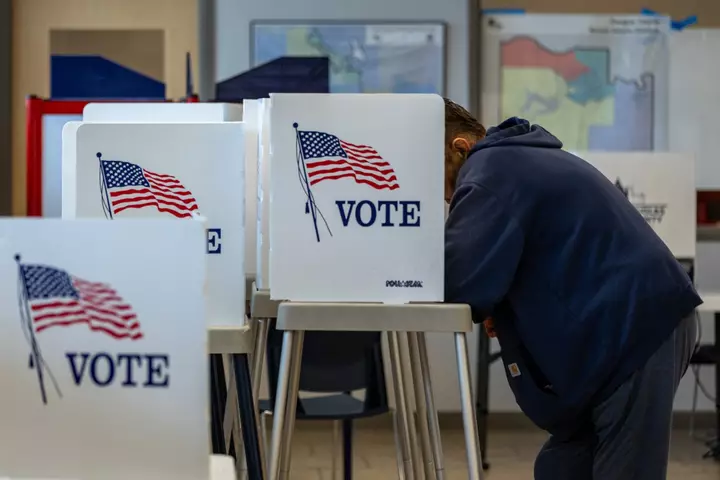
Michigan voters will decide in the upcoming November midterms whether to block certain utility companies and government contractors from donating to candidates and political committees that make decisions affecting them. Proposal 2, an initiated law, would alter Michigan’s campaign-finance laws by restricting direct and indirect campaign contributions from regulated electric and gas utilities, government contractors receiving more than $250,000 annually, and people or organizations with “substantial connections” to them. The ban would apply to contributions made to candidates running for, or officials holding, offices that affect the utilities or contractors, according to the official ballot language published by the Michigan Bureau of Elections.
The proposal would amend the Michigan Campaign Finance Act if approved by voters. "More than half a million people across Michigan signed our petition to put Proposal 2 on the ballot, and now the moment for voters to take our government back from powerful corporate interests is here. It’s past time we end the corrupt pay-to-play system that dominates our state politics and make sure it’s our voices that are heard, not the voices of big corporations bankrolling our politicians," said Christy McGillivray, executive board co-chair of Michiganders for Money Out of Politics, who led the initiative, said in a statement provided to Newsweek.
McGillivray added: "With families across the country struggling to make ends meet, Michigan’s Proposal 2 is poised to become a model for the nation for how we can tackle the worsening affordability crisis head on by rooting out corporate greed and big money in politics. Proposal 2 is proof that everyday people have the power to stand up to powerful corporate interests.” John Sellek, a spokesperson for Protect MI Free Speech, which opposes Proposal 2, told Newsweek: "Voters should oppose Proposal 2 because it uses voter frustration with the cost of living as cover to carry out a much wider sneak attack on the freedom of speech rights of thousands of innocent, everyday Michigan residents who would be banned from supporting the candidates of their choice simply because of who they are related to or contract with. Meanwhile. out-of-state billionaires can continue spending as they please to influence Michigan's public policy making.
"Worse yet, Prop 2 is a betrayal of its own supporters because it claims to get money out of politics but uses millions in dark money from mystery donors outside our state to fund its effort." The vote comes after an August report found that political action committees associated with Michigan’s two largest utilities had reduced spending ahead of that month’s primary compared with previous midterm cycles. A Michigan Information & Research Service (MIRS) review of campaign finance records found that PACs connected to DTE Energy and Consumers Energy spent less through the second quarter of 2026 than during the equivalent periods in 2014, 2018 and 2022. According to MIRS, the Consumers Energy employee PAC spent more than $120,000 through the second quarter, compared with nearly $202,000 over the same period in 2022, more than $159,000 in 2018, and more than $142,000 in 2014.
DTE’s PAC spent nearly $154,000 through the second quarter of 2026, MIRS reported. That compared with nearly $204,000 by the same point in 2022, around $242,000 in 2018 and almost $260,000 in 2014, it said. DTE publishes a list of contributions made by its Michigan PAC.
The company says the PAC is nonpartisan, funded by voluntary contributions from eligible employees and guided by an elected Steering Committee of PAC members. The company’s 2025 disclosure shows contributions to Democratic and Republican candidates and committees, as well as numerous organizations it categorized as unaffiliated. The document showed that the PAC repeatedly gave to the Michigan House Democratic Fund, Michigan Senate Democratic Fund, House Republican Campaign Committee and Senate Republican Campaign Committee during the year.
Extract — continue reading at the source.