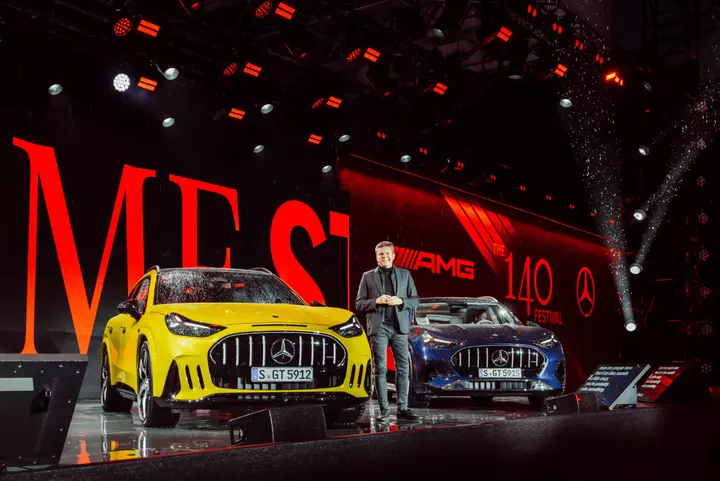
The last half-decade in the automobile industry has been marked by strategic, expensive recalculations after consumer buying behavior did not go the way the industry and its analysts thought it would. Mercedes-Benz is not an exception to the rule, but it has reacted faster than many other automakers by employing a cookie cutter-like approach to save capital while still delivering what customers are asking for. That’s not to say it’s all going well.
The company has not been immune to the cratering imported new car market in China. Sales there are down 29% in Q1 to Q3 2026 versus the same time period in 2025. Unlike other companies that have scrambled to get product to market, creating fresh-ish models from an arsenal of gas-powered engines and offering customers a bevy of special editions and new trim levels to boost interest, the company has taken a top-to-bottom strategic review of its operations under consideration and is playing the long game.
This is all while distributing distributed approximately $4.97 billion back to shareholders at the end of the last fiscal year. Considerations made for the business atmosphere of today are best represented by the refreshed versions of the two-row GLE and three-row GLS SUVs. With them, Mercedes made strategic investments in their engines and software rather than go all-in on a new platform and completely revised bodywork.
The formula mostly works unless you're nitpick-y about stability, with the SUVs delivering on customer technology asks while pushing just far enough forward that the models should be easily cross-shopped with fresher Audi and BMW models without comparatively looking like dinosaurs. "Mercedes is making a significant bet that keeping the GLE and GLS fresh underneath the skin will be enough. These are hugely important products in the U.S., but buyers in this segment have plenty of choices, and competitors are bringing genuinely new vehicles to market.
Better technology and powertrains can absolutely extend their shelf life, but Mercedes is asking customers to recognize how much has changed in vehicles that still look familiar. That’s a meaningful risk for two of the brand’s biggest U.S. products," Paul Waatti, director of industry analysis at Auto Pacific, told Newsweek. The two vehicles traditionally represent over one-quarter of all new passenger vehicle sales by Mercedes-Benz in the U.S.
While it didn’t go full throttle with the GLE and GLS, it did with the new Mercedes-AMG GT SUV, the sister product to the new all-electric GT sedan with the prolix name. It comes complete with new-age axial flux motors that deliver 1,169 horsepower for driver use and rides on the same unique-to-AMG platform that the Mercedes-AMG GT 4-Door Coupé does. It’s closer to a Ferrari Purosangue than a BMW iX3 or Lamborghini Urus, a deliberate choice that former Mercedes-AMG CEO Michael Schiebe previewed to Newsweek two years ago.
Extract — continue reading at the source.