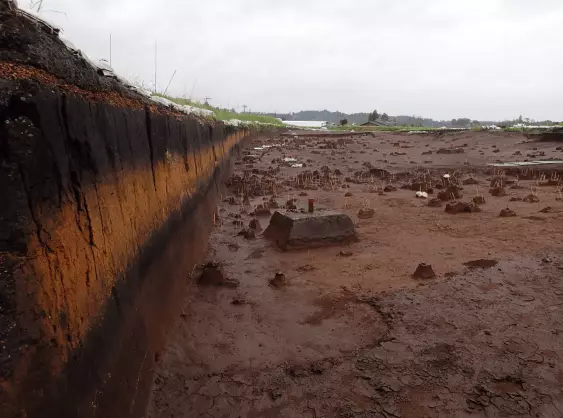
Around 5,250 BCE a series of volcanic activity rocked Japan’s southernmost island, Kyushu. Known as the Kikai-Akahoya eruption, the blast was enormous, notching a seven on the Volcanic Explosivity Index (which only goes up to eight), and causing waves of destruction that ravaged the greater archipelago. According to traditional views of the fallout, local groups were immediately annihilated and the area was eventually resettled, as evidenced by the layer of volcanic ash separating one disappearing style of pottery from another in the island’s archaeological record.
But after further investigation, another school of thought emerged. Some styles of pottery managed to survive—even on Kyushu. So the “Jomon survival” scenario arose as a counterweight to the “Jomo apocalypse” doomsayers.
Now Jordan and his colleagues are out with a new study in Science Advances, further complicating things. To find out how the apocalyptic event affected population numbers throughout Japan, an international team of archaeologists turned to radiocarbon dating data. Using time-frequency of radiocarbon dates as a proxy for population (essentially, more stuff means a higher population), the team was able to apply statistical models to estimate population changes after the eruption.
Their findings point to a more nuanced scenario, somewhere in between annihilation and continuity. While Jomom population numbers dropped precipitously in the immediate area, they actually increased in nearby locales. The areas closest to ground zero had been in decline for some time, so the region was sparsely populated when the eruptions occurred.
Additionally, populations near the northern coastline grew after the disaster, even though the countryside was ecologically destroyed (potentially because the marine ecosystem wasn’t hit as hard). According to the team, these findings suggest refugees from the eruption managed to hold on, migrate, and continue their lives. Subscribe to our free newsletter.
Extract — continue reading at the source.