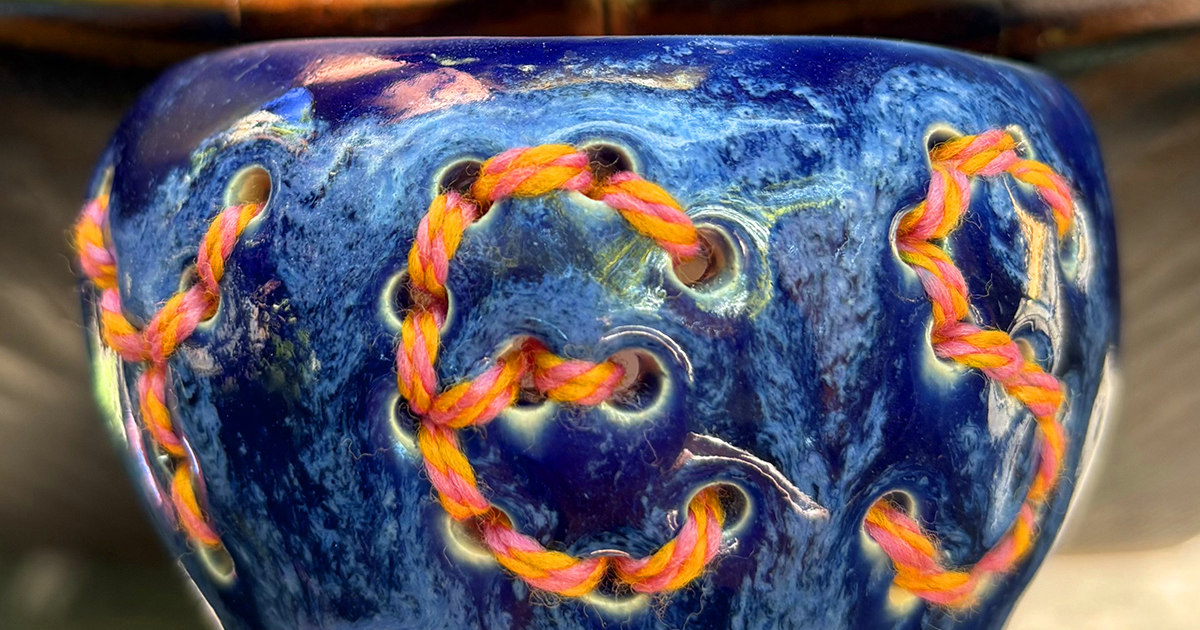
It started with an urn for living gone wrong, the clay kiltering off center, resisting my every effort to force it back into shape. The harder I pushed to control it, the more it took on a life of its own, folding like flesh, bending like mind. I pushed and despaired, pushed and despaired, until, exhausted and exasperated, I gave up and simply let my hands follow the momentum of the clay, saying “YES” to its will.
And then, magic: I watched the vessel turn into what I could have never imagined, never created by force: an enormous seashell, a miniature Guggenheim, a great open ear — asymmetrical yet perfect in its secret logic, the proof beyond the postulate. Here was an antidote to all the urns and bowls I had controlled into perfect symmetry, almost factory-like, pushing so hard to center that a stress injury incapacitated my left arm for seven months. Here was a hard, fragile material — pulverized stone that vitrifies like glass — taking a soft, organic shape.
I found myself wondering what life itself would be like if, rather than willing it to conform to our design only to end up in despair, we simply said “YES” to its will, collaborating with rather than resisting the centrifugal force of the heart, the angular momentum of memory, the gravity of change. All things not pliant enough to bend will break — fragility is a function of rigidity. We contact this elemental law most clearly and most painfully in relationships, which have a will of their own greater than the sum of two intents and which are never, however reciprocal, perfectly symmetrical.
Have too rigid an idea of what a relationship should be, and it will inevitably shatter; look back on the most enduring and rewarding relationships of your life, and you will discover that they have found their own right form, different from your first intent, a form that is never final. And yet, paradoxically, rupture and repair are how relationships are stress-tested and fortified across the long horizon of life. In this regard, love is more like embroidery than like pottery — you make a hole to make a stitch.
So began a daily practice of collaborating with rather than forcing the clay, then embroidering the result — vessels to hold a life that says “YES” to itself, a life needful of constant reminding that all things forced are false and fragile. We need these reminders, all of us, if we are to be true to our own hearts. And so, as with my other ceramics, I am letting the impartial hand of chance, which forces nothing yet shapes everything, give a dozen of these vessels — yessels? — away: To enter the raffle, make a donation by November 30 in any amount that feels unforced for you, so long as you end it with the decimal .12, whether it is $1.12 or $1,000.12. (For greater odds, consider joining my twentieth anniversary celebration — another set will be raffled off at the Museum of Delight there.) And because the hand and the mind, the body and the spirit, are in constant conversation, somewhere along the way of this reckoning with life in clay and thread, a poem wrote itself in me: VESPER FOR A BURNING WORLD by Maria Popova You need not be a saint, stripped bare of all desire, or a savior, dragging the drowning out of their pain by the regret-stained collar of their discontent.
You need not leaven the world’s heavy toll of hope by propping the sky up with your sunburnt hands or fence yourself off in the flowerless meadow of detachment. All you need to do is look in the mirror of morning and say “Yes.” — Published October 1, 2026 — https://www.themarginalian.org/2026/10/01/yes/ — The Marginalian participates in the Bookshop.org and Amazon.com affiliate programs, designed to provide a means for sites to earn commissions by linking to books. In more human terms, this means that whenever you buy a book from a link here, I receive a small percentage of its price, which goes straight back into my own colossal biblioexpenses.
Extract — continue reading at the source.