It is in relationships that we discover both our depths and our limits, there that we anneal ourselves and transcend ourselves, there that we are hurt the most and there that we find the most healing. But despite what a crucible of our emotional and spiritual lives relationships are — or perhaps precisely because of it — they can be riddling and nebulous, destabilizing in their fluidity and ambiguity, leaving us grasping for the comforting solidity of categories and labels. The ancient Greeks, in their pioneering effort to order the chaos of the cosmos, neatly taxonomized them into filial love (the kind we feel for siblings, children, parents, and friends), eros (the love of lovers), and agape (the deepest, purest, most impersonal and spiritual love).
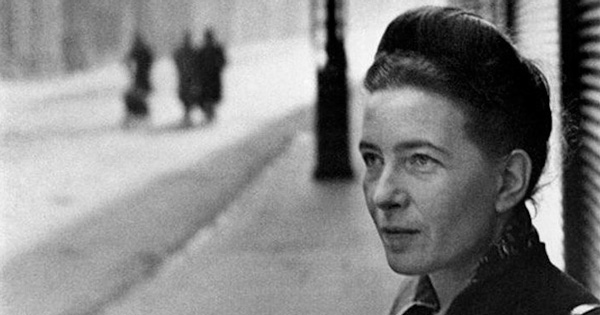
After the Enlightenment discounted all love as a malfunction of reason, the Romantics reclaimed it and revised the ancient taxonomy into a hierarchy, under the tyranny of which we still live, placing eros at the pinnacle of human existence. And yet our deepest relationships — the ones in which we both become most fully ourselves and are most emboldened to change — tend to elude the commonplace classifications and to shape-shift across the span of life. Simone de Beauvoir (January 9, 1908–April 14, 1986) was only nineteen when she wielded her uncommon intellect at these questions on the pages of her journal, later published as Diary of a Philosophy Student (public library).
In between composing her resolutions for a life worth living, Beauvoir began thinking seriously about the nature of love, its dialogue with her own nature, what she may want of it and what it may demand of her — “in brief, how souls can interact with one another.” In the midst of an intellectual infatuation with a young man who would go on to become an eminent philosopher himself — not the one she would eventually marry in a convention-breaking union of minds — she examines the substance of the feeling: To say that I love him, what does that mean? Does the word itself have a meaning? Questioning the tangle of idolization and desire that masquerades as love, she grows suspicious of the very concept of personal love as an absurdity against the backdrop of the largest love we can carry: When you love beings… not for their intelligence, etc., but for what they have in their very depths, for their soul… you love them equally: they are entireties, perfect inasmuch as they are (to be = perfection).
Why then is there this desire to get closer? To know them, and thus to love them more perfectly for what they really are. What is surprising is not that we love them all, but rather that we prefer one of them.
Invoking the love she feels for her friends, the sum total of them, she writes: Something sharp runs through me which is my love for them… This is not intellectual love. This is a love for souls, from all of me towards all of them in their entirety. Over and over she returns to the elemental question: What then is love?
Not much, not much… Sensitivity, imagination, fatigue, and this effort to depend on another; the taste for the mystery of the other and the need to admire… What is worthwhile, is friendship… this profound mutual confidence between [two people], and this joy of knowing that the other exists. Drawing on Hegel’s philosophy of freedom, in which for any conscious subject to be free means freeing the other, she arrives at a “formula” for the ideal friendship: “absolute reciprocity and the identity of consciousness.” The cultural ideal of romantic love, on the other hand, replaces this “absolute reciprocity” with engulfment and sublimation of one self into the other. She writes: It seems to me that love should not make all else disappear but should simply tint it with new nuances; I would like a love that accompanies me through life, not that absorbs all my life.
Extract — continue reading at the source.