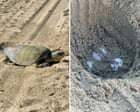
A sea turtle crawled out of the surf in southern California last weekend around sunset and started laying eggs in the sand. People on Huntington Beach who saw the female olive ridley sea turtle were shocked and excited. And they weren’t the only ones freaking out, said Justin Viezbicke, the California stranding coordinator for the National Oceanic and Atmospheric Association (Noaa).
What made the sighting even more noteworthy is that two different olive ridley sea turtles were identified laying eggs on Orange county beaches in the last week, the first on Seal Beach and the second on Huntington Beach. It’s a pattern that has scientists questioning whether the nestings are a freak occurrence, or the beginnings of a more lasting trend. While early news reports suggested that a single female turtle laid eggs on both California beaches, scientists further analyzed photographs of the turtles’ shell shape and barnacle patterns and determined that two separate olive ridley turtles had begun nesting on the US coast, Viezbicke said.
Olive ridley turtles typically lay their eggs on beaches much further to the south, in Mexico and Central America, Viezbicke said. What caused the turtles to begin nesting further north than usual is the “million dollar question”, he said. Scientists are examining several different theories, including the environmental factor of warmer coastal waters, to other effects of El Niño, or whether the turtles “could have been blown off course by the recent hurricane”.
While it’s too soon to tell, it’s also possible that these first recorded US coastal nests could herald a broader northward shift in the olive ridley turtle’s nesting patterns, one driven by climate crisis and the warming ocean waters in the turtles’ native nesting areas, said Lance Adams, an aquarium veterinarian at the Aquarium of the Pacific in Long Beach. The sex of the olive ridley turtle is determined by temperatures where the eggs hatch, and warmer temperatures produce more female turtles. To achieve a balanced population, the sea turtles might need access to cooler nesting areas.
On the other hand, it’s hard to generalize from just two sightings, Adams said: “The turtles could be here by mistake.” Because the nesting season is not over and individual olive ridley turtles typically lay multiple nests of eggs, “We might see additional sea turtles making beach crawls to nest in the next 30 to 90 days,” Adams said. For protection, the new turtle nests have been surrounded by fencing. But there’s only so much local officials can do to protect the eggs, which typically take 45 to 60 days to hatch, Viezbicke said.
It’s not just the dangers from local predators, such as coyotes, or from interfering humans. New hurricane swells and high tides are expected as soon as Monday of next week, Viezbicke said – and there’s a risk of the extreme weather “washing away that part of the beach”. Californians who spot sea turtles on a local beach should not interfere with them, and should keep at least 50 ft away, Adams, the aquarium veterinarian, advised.
Extract — continue reading at the source.