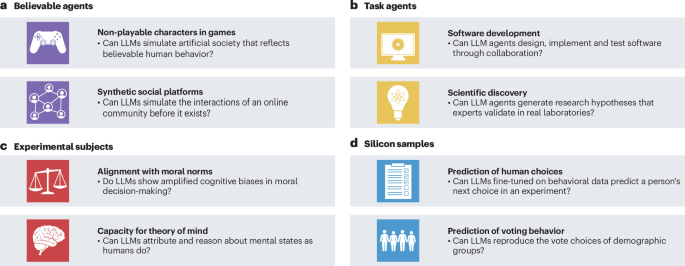
The idea of computationally approximating human behavior is being reshaped by the emergence of large language models (LLMs). Although LLMs do not explain the mechanisms of human behavior, they can potentially stand in for humans—giving rise to new applied and scientific uses. Here we analyze research from multiple disciplines that explicitly or implicitly use LLMs as human proxies and organize them into four roles: believable agents, task agents, experimental subjects and silicon samples.
By comparing the roles, we show that similarity to humans is not a single feature: each supports a different scientific claim and requires its own validity criteria. This is a preview of subscription content, access via your institution Access Nature and 54 other Nature Portfolio journals Get Nature+, our best-value online-access subscription Receive 12 digital issues and online access to articles Prices may be subject to local taxes which are calculated during checkout Anderson, J. The Atomic Components of Thought (Lawrence Erlbaum Associates, 1998).
AI Mag. 27, 96–108 (2006). The Sciences of the Artificial 3rd edn (MIT Press, 1996). Growing Artificial Societies: Social Science from the Bottom Up https://doi.org/10.7551/mitpress/3374.001.0001 (MIT Press, 1996).
Language models are few-shot learners. Syst. 33, 1877–1901 (2020). On the opportunities and risks of foundation models.
Preprint at https://doi.org/10.48550/arXiv.2108.07258 (2022). Gao, Y., Lee, D., Burtch, G. & Fazelpour, S. Take caution in using LLMs as human surrogates.
USA 122, e2501660122 (2025). J., Filippas, A. & Manning, B. Large language models as simulated economic agents: what can we learn from homo silicus?
Extract — continue reading at the source.


