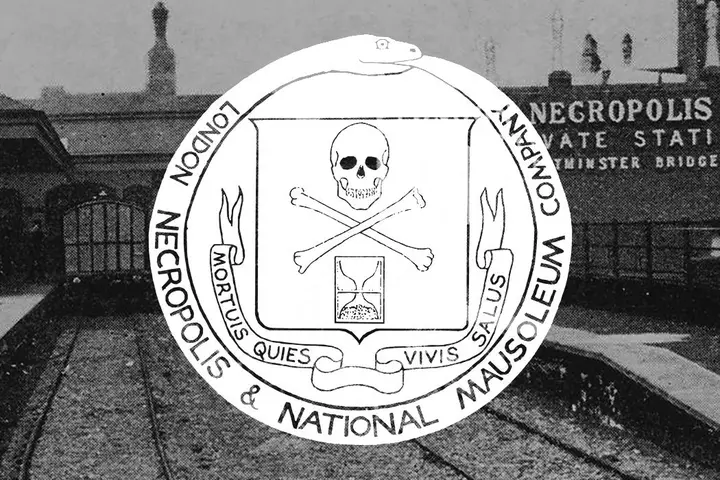
The final journey for London’s dead, circa 1860, was a trip on the London Necropolis Railway. The train would take the corpse and the accompanying mourners out of the city to the sprawling Brookwood Cemetery, where they had their pick of two stations: one for Anglicans, one for Non-Conformists. The deceased rode first, second, or third class (to avoid posthumous intermingling of rich and poor).
But naturally, all coffin tickets were one way only. Brookwood Cemetery was established in 1854 by the London Necropolis and National Mausoleum Company. Founded in response to a crisis of overcrowding in London’s churchyards, it was intended to hold all of London’s dead, for the rest of time—the vast majority of them in unmarked paupers’ graves.
At the time, the city’s population had grown far beyond what its existing patchwork of small graveyards could accommodate. Gravediggers forced as many bodies into one grave as they could, sometimes breaking apart the cadavers “with choppers and pickaxes” in order to make them fit. While they were at it, they could make a little extra cash by stripping down the old caskets to resell the handles and nails.
Graves were reopened so often that the grass had no time to grow over them. Death was not dignified: the dearly departed lay in black mud scattered with litter. A series of cholera epidemics, starting in 1832, turned the situation from an aesthetic nuisance into a serious health hazard.
Rumors circulated about people who died gruesome deaths after simply breathing in the miasmatic vapors that rolled off an open grave. In 1850, a new Burials Act banned the use of churchyards for future burials, necessitating a speedy solution for London’s dead. The very next year, the London Necropolis and National Mausoleum Company purchased a massive tract of land outside the city on a major rail line.
Besides providing ample room, the company developed a cheap “earth-to-earth” coffin, made of biodegradable wood pulp, which would speed decomposition rather than allowing unwholesome vapours to linger. The bishop of London, for one, was a firm opponent. He was concerned about the impropriety of a for-profit company dealing with the dead, and disturbed that all of London’s dead—however upstanding or immoral they may have been in life—would travel together on the same train, and wind up in the same final resting place.
Extract — continue reading at the source.