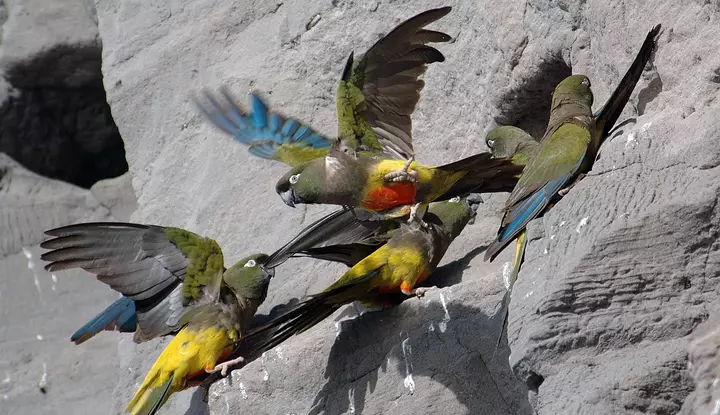
Near Patagonia's El Cóndor lies the largest known colony of burrowing parrots: It accounts for 71 percent of the species’ global breeding population. On a sandstone cliff facing the Atlantic Ocean, breeding couples dig burrows up to 11 feet deep to nest. Loud, colorful and on edge: The lives of Argentina’s burrowing parrots Decades of work helped establish a refuge for these birds along the Argentinean coast — the largest and last colony of its kind.
But their future remains precarious. The Argentinean Patagonia is known for its right whales, penguins, guanacos and elephant seals. But a lesser-known species, the burrowing parrot, also arrives there every year to nest and raise its chicks.
The world’s largest colony of these boisterous green birds dwell within a sandstone cliff that runs 21 kilometers (13 miles) along the Atlantic Ocean. The creatures are members of one of the most endangered groups of birds, the order Psittaciformes, which includes macaws and cockatoos. In the hopes of shoring up their future, a team of scientists has been monitoring the parrots for three decades, documenting their breeding activities, population fluctuations and their roles in the ecosystem.
The accumulated findings led to the creation of a nature reserve in the area to protect them. Easily recognizable by the olive-green plumage on their heads, blue tones in their wings, and yellowish and reddish tones on their bellies, the species, _Cyanoliseus patagonus_, are known as burrowing parrots because they excavate their nests in the ravines of rivers and streams or in cliffs facing the sea. Even the older chicks help expand these nests,” says Mauricio Failla, a biologist who has been part of the Burrowing Parrot Project since 2001.
The long-studied colony is in the town of El Cóndor, near the estuary of the Río Negro in northeastern Argentinean Patagonia, and accounts for 71 percent of the breeding population of the species. _C. patagonus_ was once abundant, with a wide range in Argentina and Chile, but its numbers began to decline in the mid-19th century due to habitat loss and degradation, capture for the pet trade, and targeting because they were considered crop pests. The research at El Cóndor, led by Juan Masello and Petra Quillfeldt, a husband-wife team of biologists at the University of Giessen in Germany, started in 1998. Masello describes the exuberant, constantly calling colony as a riot of color and joy for life: “Seeing and hearing them fills my soul.” The species also has strong family bonds.
The birds choose a single mate with whom they remain for life and collaborate in their parenting, with older chicks helping to feed their siblings. Every year, during the nesting season of these migratory birds — which begins in August with nest preparation and culminates in December when the two to five new chicks per couple are ready to fly — scientists have monitored the nests. At first, they relied solely on photographs that were taken after reaching the site on foot or climbing up to it — “a logistical challenge,” says Masello, that’s possible only during low tide.
Extract — continue reading at the source.