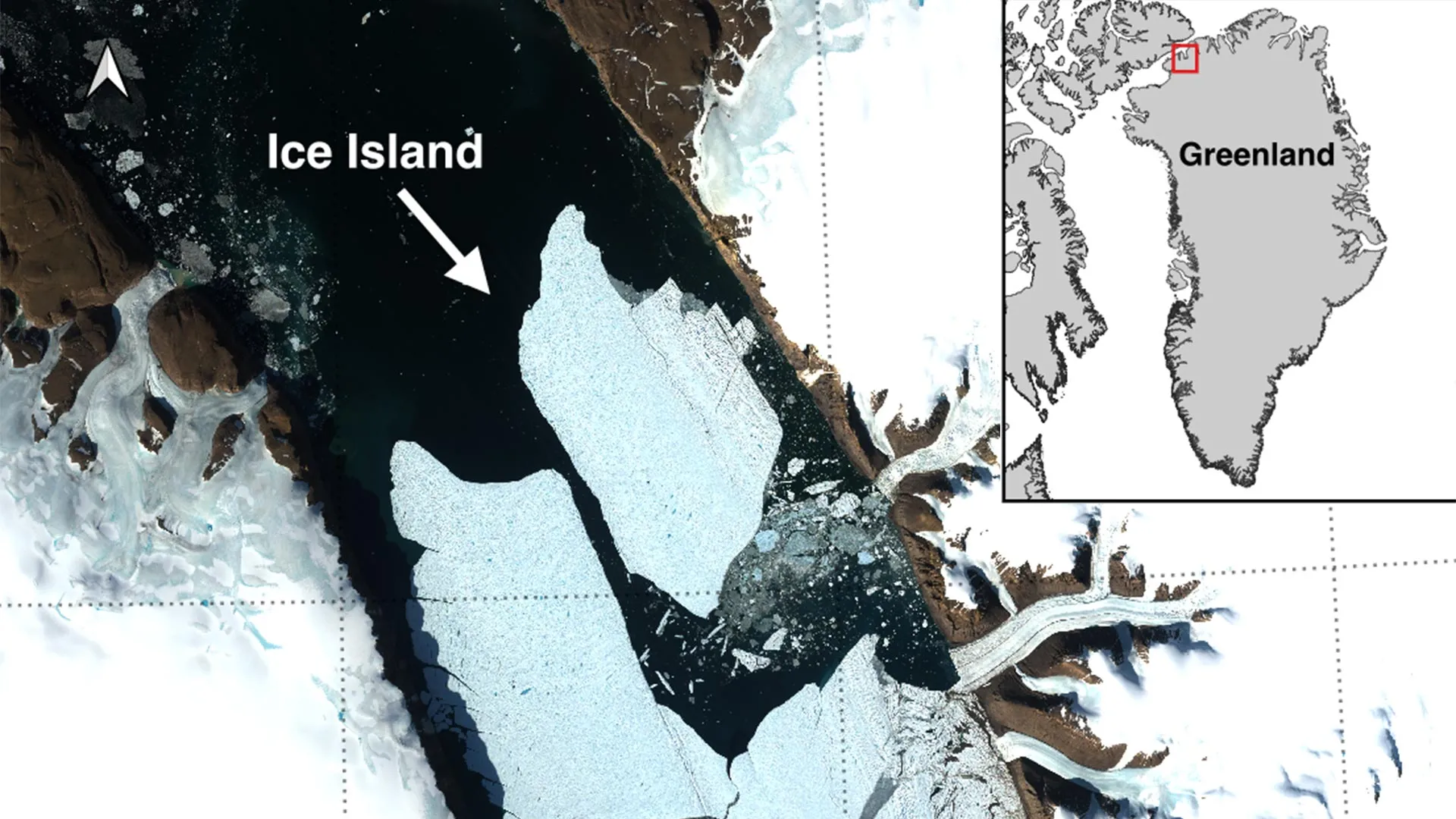
An international team of researchers, led in part by the University of Ottawa, has documented a major calving event at Petermann Glacier in northwest Greenland. On August 4, 2026, the glacier released a 76.4 km2 ice island, its largest loss of floating ice since 2012 and the biggest Arctic calving event since 2020. The newly separated tabular iceberg broke away from Petermann Glacier's floating ice tongue and may be as much as 150 meters thick.
Its surface area is roughly comparable to Manhattan Island, giving scientists a rare opportunity to observe how enormous Arctic ice masses develop, move through the ocean and eventually fragment. The event was identified by Adam Garbo, a PhD student in glaciology at uOttawa's Department of Geography, Environment and Geomatics. The discovery is part of an ongoing collaboration involving the University of Ottawa, the University of Stirling, Environment and Climate Change Canada, Lancaster University, and the University of Leeds.
Satellite Monitoring Revealed Years of Growing Instability Scientists have been tracking changes at Petermann Glacier with long-term satellite observations since 2019. Over that period, they closely followed the condition of the glacier's floating ice tongue, recording the expansion of fractures and watching for signs that a major section might eventually break away. "Petermann Glacier has long been one of Greenland's largest remaining ice tongues," says Garbo.
"We've anticipated this break for years, and seeing it finally happen is remarkable." Images collected by the European Space Agency's Sentinel-1 mission showed clear signs of deterioration along the centerline of the ice tongue on August 3. By on August 4, the new ice island had fully separated from the glacier's eastern side. Rare Arctic Ice Islands Offer a Window Into Polar Change Large, flat-topped icebergs are relatively common around Antarctica, but comparable ice islands are much less frequently seen in the Arctic.
Their rarity and longevity make them especially valuable to researchers studying glacier retreat, changing ocean conditions and the risks posed by drifting ice in polar regions. "While large, tabular icebergs are relatively common in the Southern Ocean that surrounds the Antarctic Ice Sheet, Arctic ice islands are far rarer," explains Dr. Anna Crawford of the University of Stirling.
"By studying Arctic ice islands, we will gain knowledge that can be transferred across Polar regions." Scientists do not expect the August calving event to be the last major change at Petermann Glacier. Two additional large sections of the floating ice tongue are expected to detach in the near future as rifts that have been developing for years continue to cut through the ice. Those future ice islands are projected to measure about 94 km2 and 84 km2.
Extract — continue reading at the source.


