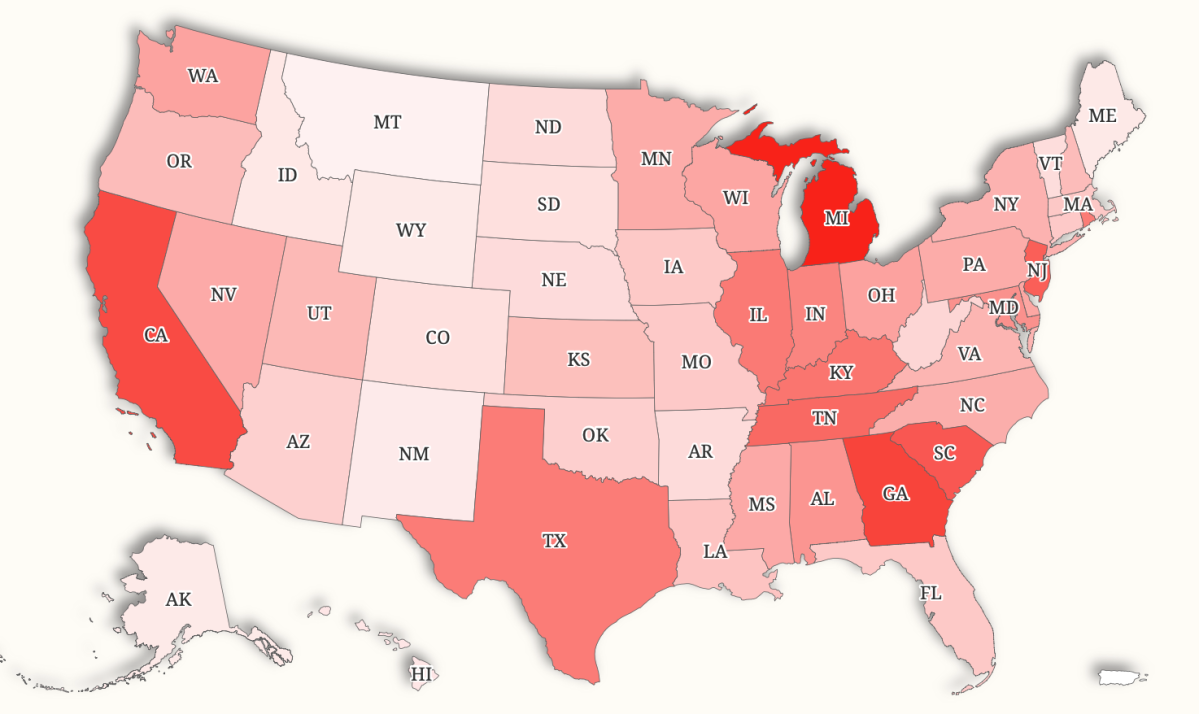
President Donald Trump’s tariff agenda has reshaped the cost of importing goods into the United States, but the impact has been far from evenly distributed across the country. The new estimates show a particularly wide divide between states, with exposure determined both by how much states import and by the types of goods moving through their economies. Manufacturing and the auto industry feature heavily among the states facing the largest costs.
The figures come from the National Taxpayers Union Foundation’s (NTUF) State Tariffs Tracker, using estimates prepared by Trade Partnership Worldwide. They measure additional tariffs paid on imports into each state since January 2025 and currently cover data through June 2026. They are estimates rather than customs receipts or a calculation of each state’s overall economic losses.
Tariffs have been a defining feature of Trump’s economic agenda since he returned to office in January 2025, with the administration using import taxes not only as a trade policy but also as leverage to encourage manufacturing in the U.S. and extract concessions from trading partners. But tariffs can feed through to what businesses and consumers pay. Federal Reserve researchers estimated in April that tariffs imposed through November 2025 had raised core goods prices by 3.1 percent through February 2026 and boosted overall core personal consumption expenditure prices by 0.8 percent.
Newsweek has contacted the White House for comment via email outside of regular working hours and is awaiting a response. California has faced the largest total cost of any state, at an estimated $63 billion. Cars and trucks account for $7 billion in additional tariffs, while clothes and shoes account for $5.1 billion and batteries and cables $4.1 billion.
Around 45 percent of the state’s tariff costs fall on raw materials, parts and equipment bought by manufacturers. Texas ranks second at $37 billion, with manufacturing exposure even more pronounced. Around 71 percent of its tariff costs apply to manufacturing inputs.
Cars and trucks account for $5.7 billion, followed by $3.3 billion from steel, aluminum and other metals. Michigan is third at $23 billion, with the automotive industry dominating its exposure. Cars and trucks alone account for $10 billion of the total and auto parts another $5 billion.
Extract — continue reading at the source.